Wednesday, July 26, 2006


The back of the ship. Sorry I'm not better with the nautical terms. Help me out...uh...hull?

A statue of a girl with open arms, expelling seagulls from her groin.

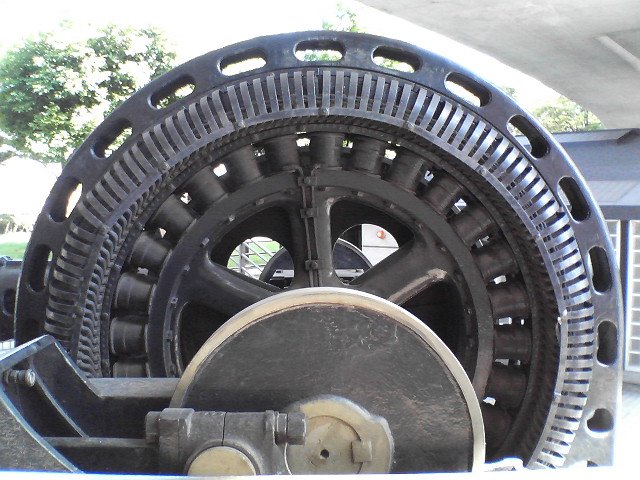
Here is a giant pneumatic thingy that was very important to ships and sailing and nautical stuff in many important ways. Such as...um...the...uh...

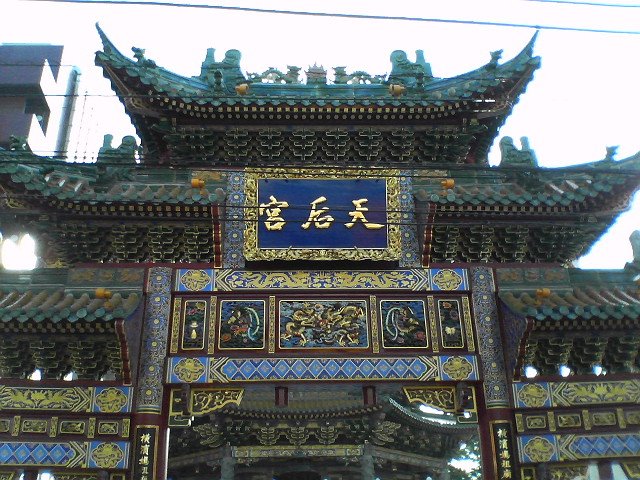
Here is the entrance to Yokohama's famous Chinatown, the largest Chinatown in Japan. The gates were created to mimic the architecture found at the Emperor's Summer Palace, a building that I actually visited during my trip to Beijing. Most of the people working in Chinatown were actually Chinese immigrants. While fluent in Japanese, their speech was heavily accented and at times very difficult to understand.

Here is a giant gate with pagoda in the background, the main attraction of Yokohama's Chinatown. These Japanese copies were more impressive than the real thing I saw in Beijing.

Another Chinese inspired building in, you guessed it, Chinatown!

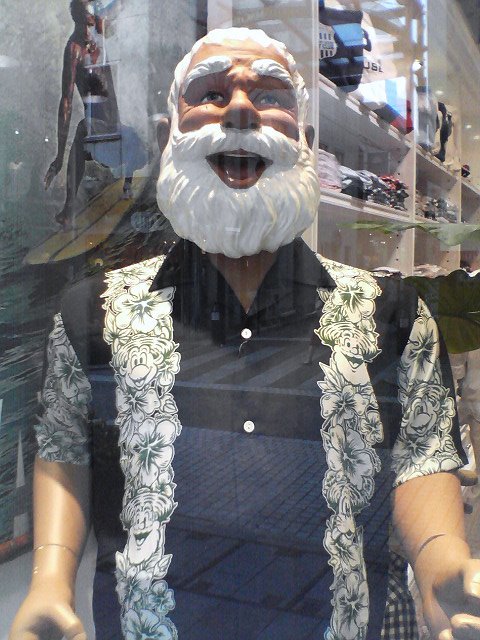
If you've been a reader of this blog since the beginning, then you are already familiar with Captain Santa. If not, you're in for a treat! Captain Santa is the tropical themed, yacht sailing, senior citizen Claus who serves as the mascot for a line of khaki shorts and California surfer-themed clothing wear marketed at older men in their 50's and 60's. Captain Santa has a group of supporting character known as "The Captain's Crew." One member is a dog who looks like Disney's Pluto and the other is a moose who bares more than a passing resemblance to the Mariner Moose.

Yay for globalization! See's is just starting in Japan and they only have a handful of stores throughout the country. When I asked for a free sample, the high school girls working behind the counter started laughing. I told them that in America See's Candies offers free samples. They said that they can't offer free samples in Japan because it costs so much to manufacture the chocolate. Judging from the price tags in the store, I'd say they weren't lying.

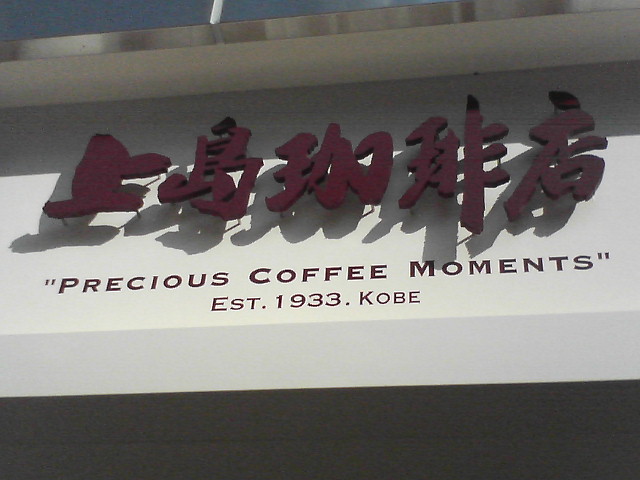
When was the last time YOU had a precious coffee moment? If you're my roommate Bryce, chances are you're having one right now.

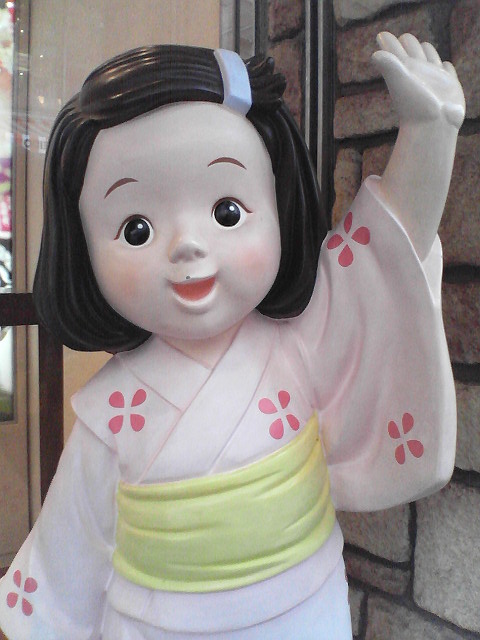
A cute kimono girl. Bye bye!

Business Lingo

It occurred to me that I forgot to include the most important phrases in Japanese business in my last post about the proper way to meet celebrities. Because I’d like to think that this blog is educational as well as entertaining, here comes a foreign language lesson that some might find rather boring.

If you’ve studied any Japanese, you have likely learned that the phrase “ohayoh gozaimasu” means good morning. This is true. However, as Shimura Bucho explained to me, you also say ohayoh gozaimasu when you meet someone of outstandingly high status. This would be a person that you do not see on a regular basis and are not likely to see again in the near future. In situations like this, no matter what time of day it is, it is appropriate use the greeting ohayoh gozaimasu.

The opposite of ohayoh gozaimasu (when used to greet a superior) is the super casual term Ossu! Ossu is the equivalent of “Hey” or “Yo,” and is used when you meet up with the boys or team members from your company. Ossu was once only exclusively by males, but nowadays girls are starting to use it as well. It is perfectly appropriate to extend the “ssss” sound at the end of the phrase when greeting people, thus mimicking Gollum from Lord of The Rings.

The other required business phrase is “otsukaresama-desu” (present tense). This phrase can be translated into English to mean anything from, “thanks for your effort” to “let’s throw back beers like there’s no tomorrow!” The phrase is usually spoken at the end of the workday (or after one has just completed a project), and expresses thanks for a day’s hard work. Somewhat confusingly however, if you are in an office environment, people will often use the phrase as a substitute for konnichiwa. In situations like this, the phrase merely means hello.

After the NHK enka TV show filming I attended, all my co-workers and I had to stand upright in a line and bow to every single singer, dancer, producer, publicist, manager, and tech person as they left the filming area with bags in hand. Out of respect, we could not leave the studio until all of the abovementioned people associated with the filming had left before us. While lined up, at first I thought I might say “yoku dekimashita” or “you did great!” to the passing people, but I soon found that this was an inappropriate way of thanking people. The correct term to use was otsukaresama-deshita (past tense), and I said it around 10 thousand times.

B.E.W.

Tuesday, July 25, 2006


Everybody's entitled to one fluff post about candy right? A while back, Mars Candy did a campaign on TV and the world chose pink as the new M&M's color. I don't know about you, but I never found a single pink m or m in any of my packs (and the peanut variety were a frequent purchase of mine at my dorm's vending machine). I am happy to report however, that Japanese packs of M&M's do in fact contain the rare and delicious pink candies. I hope this doesn't mean that the pack I ate sat on the shelf for two years.

Monday, July 24, 2006


Today I attended a live event at a movie theater / art gallery in Shibuya. The event showcased the work of a Thai manga artist who creates simplistic cartoon stories and sets them to his own piano music (there is no other sound in the animations). For the live event, he sat at a KORG digital piano and played music along with a DVD of his animation (just like the old-style silent movies of the 1920's). He spoke virtually no Japanese, so I was actually able to introduce myself in English. The above and below pictures are from the super creepy storeroom of the art gallery, which still had a few pieces from the last twisted exhibition hanging around.

Dear Wes Craven, if you are reading this blog and are looking for a new cinematographer, please give me a call. I think we can work something out!

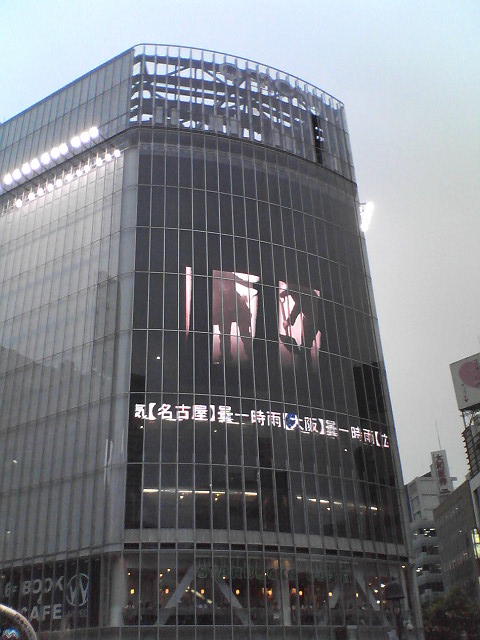
Here is the building from the movie Lost In Translation - it is directly opposite Shibuya Station at the huge crossing. The place is called the Q-Front Building. The front of the building acts as a giant TV screen and often displays movie trailers and music videos. In Lost In Translation, it displayed a giant walking brontosauras.

Sunday, July 23, 2006


Here is the Hyper Convenience U.S. Mart, part of Shinjuku's American Blvd. I passed this area while walking to a nearby movie theater to see the anime Brave Story (it turned out to be pretty crummy). A general rule is that anything which claims to be American in Japan will actually have no relation to the United States at all. This store didn't carry any American-made products and I am certain that the staff didn't speak a word of English.

Inside the place. There were more flags in this one store than on my block during the 4th of July.

Saturday, July 22, 2006

Impressions From the Entertainment Ambassador

For the next two weeks I will be working in the anime and videogame music division of CME called Columbia House. Thus, my two weeks working in Columbia Records (the enka or country music division of CME) have come to an end and I’d be lying if I said I wasn’t sad to go. My birthday was marked with a special sushi dinner with some of my co-workers, and the experience brought me even closer to them. As we drank and ate all the raw fish our bellies could handle, a friendly war of words broke out between Shimura Bucho to my left and co-worker Rurika (an interesting name even by Japanese standards) across the table.

Shimura-san kept explaining to me the subtleties in usage of the phrase “stupid idiot” as it referred not only to Rurika as a person, but her thoughts and behaviors as well. With his so-called “back alley Japanese,” he instructed me to call Rurika “wrong in the head,” sticking his tongue out as he twisted his index finder around and around by his ear. Rurika responded by telling me that Shimura-san never says any complements and instructed me to call him “a dirty old man.” While it may seem like this was a mean spirited fight, it was in fact friendly in nature, similar to a brother and sister.

This type of name-calling and play fighting is something that I’ve seen over and over again between work colleagues. I attended a BBQ last weekend with my enka section and as we drank more and more, the behavior got more in line with this observation. The section’s sub-leader began hitting everyone in the head with his folding fan. He walloped me on the head and told me to “pay attention” as he asked me in Japanese what I thought about Japanese girls’ lack of boobs and forests of pubic hair (I’m not kidding!). Indeed, I think my eyes traveled over to some of my same-aged female colleagues during our conversation, which is why he plunked his fan down on my noggin.

To some, these types of questions may seem alarming or inappropriate, but I was not caught off guard at all. As I wrote earlier, the concession in Japanese business is that your work and section colleagues are the people you trust, they are the people who know you, and they are the people you can truly be yourself around.

Returning to the point of play fighting, our BBQ concluded with a massive water fight. I’ll hazard a stereotype at this point and assert that Japanese people LOVE splashing each with water. The weapon of choice was the ice cold reservoirs of H20 that had collected in the drink coolers. Several co-workers were targeting another guy at one point and they used me as the bait. Once the mark and I struck up a conversation in Japanese, the guys ambushed him and drenched him in water. A bucket full of ice cold liquid came down over me as it did to just about everyone there. You work hard in the office so you can relax and play hard when it counts.

It is hard to believe that I have only been at work for two weeks – I have already seen and experienced so much! You can read about all the people I met below. One more celebrity should be added to the list, an older female enka singer named Kaneda Tatsue. I sat in on an interview being conducted at CME for a music magazine and got a chance to talk with her after the reporter finished.

The three people in the company who can speak English fluently (one of whom is the company president) were there with me in case I froze up during the after-hours Q&A, but we all spoke in Japanese so it worked out well. To my surprise, it was Kaneda-san’s agent who liked me the best. She said I could send her my demo tape and wants to have lunch with me because she thought my views on cultural exchange were very interesting. I guess this is because I went off on one of my favorite topics about how Japan is so important economically and culturally in the world, but yet most people see it as an impenetrable enigma. In my opinion, most people don’t know what to make of Japan. My blog probably doesn’t help this fact.

Meeting famous people is always weird, and it is made even weirder when you try to do it in a foreign language. I can say however that I am now as used to it as I am going to be and that I am rarely nervous anymore. Because Japan is a hierarchical society, the spoken language of Japanese differs when you talk to people of varying ages and social positions. The Japanese terms are sonkeigo (honorific language) and kenjyogo (humble language). Basically, it corresponds to, “anything you do is great” and “I am slime.” Thus, when I refer to “I am slime” Japanese, I speak of the way that one must humble themselves in front of superiors.

It is worth noting that these types of speech are very difficult to use effectively for both foreigners and native Japanese alike (they do not teach it in Japanese school). You in essence have to constantly adjust your speech on the fly to put down yourself and put up the other person. This is not only in meetings; it is true when one company calls another and whenever a salesperson addresses the all-valuable customer-sama.

And now, my guide on how to meet famous Japanese people:

Step 1 - Can I come in?) Unless you are a company president or have made a name for yourself in the entertainment industry, if you are meeting any sort of famous people, the chances are that you have a Japanese native insider as a guide. After your superior has knocked and the dressing room door has opened, he or she will begin with a short one or two sentence introduction about who you are and where you are from.

For instance, “This is Ben Wha…Whele…Whe…Whaaa…uh…(pause)…Ben-san. He is completing an internship program at Columbia Music Entertainment and is a student from Stanford University.” At this point, the famous person will glance in your direction and ask the Japanese superior a benign question about you without acknowledging your presence. An example question would be, “Is Stanford University located in Boston?

Step 2 - Entering) When it is your time to enter, the Japanese superior will flutter his upturned hand in your direction. As you enter the room you must first bow deeply and say a set phrase in Japanese which translates into, “I am very sorry for disturbing you and I apologize for the hindrance of my plump and unsightly American face.” When standing, it is important that you stand upright with your hands at your sides (if you are a boy), or your hands placed in front of your abdomen, one placed on top of the other, (if you are a girl). It is also very important that you stand as close to the door as possible. This is the most vulnerable position in a room in Japan and it signifies that you do not intend to stay long and are on your way out.

You are to stay standing upright and not sit unless instructed to do so by your host. If you are asked to sit, you must either completely rest both feet flat on the floor, or completely fold one leg over the other to create a stereotypically homosexual image, while squishing your private parts to the side of your opposing leg. An average guy’s most common way of sitting where one rests the foot of one leg on the opposing knee of the other, thus forming a triangle shape with their legs, is an automatic “batsu” (X). Feet are considered uncleanly in Japan, and in any sort of formal occasion, showing the soles of your feet to a guest is considered very impolite.

Step 3 – Introduction) You must now say a self introduction in Japanese using the appropriate “I am slime” form which explains your humble circumstances. You must not introduce yourself for too long; a length of two sentences is appropriate. When I met my first famous person, I introduced myself for way too long and saw the glaring eyes of my Japanese superior like the rising music at the Oscars as a sign that it was time to wrap up.

Step 4 – Q&A) If it is a short Q&A session you will only have the opportunity to explain that Stanford University is located in the state of California and give a brief overview of the geography of the United States. If it is a longer Q&A session, be prepared to explain your interest in Japan, what is hard / easy about studying Japanese as a foreign language, the fact that Americans do in fact eat white rice, and anything that you were particularly “surprised by” since coming to Japan. Differing from Westerners, Japanese people are much more interested in your opinions and experiences as an outsider in their society, rather than your life and family history. If you do get questions about your life, it will likely be superficial things such as, “What kind of place is city X” or “Do lots of people know about sushi where you live?”

Step 5 – Wrapping up) Depending on how engaged the famous person is, there may or may not be a section where you two stare at each other while reaching for something to say. In any event, this awkward silence will almost always be ended by your superior, who will signal that it is time to go. It is strange, but you can always feel when this time is coming so you don’t have to worry about overstaying your welcome.

Step 6 – Leaving) You are to leave as you came, by bowing deeply (this may be followed-up by several short bows in rapid succession), thanking the person for their time profusely, and saying a set phrase in Japanese which translates into, “I am leaving now. Your time has been a peach blossom scented blessing and I apologize for the lingering stench of my presence.”

There you have it - How to meet a famous person in a nutshell!

I’d like to close this post with a method to live by; “Put in Effort” or in Japanese, “Doryoku o Ireru.” If you are a foreigner living and working in a different country as I am, it is no surprise to any native that you do not fit in. In fact, no matter how well you may know the customs, speak the language, adopt the slang, or hold hands with a partner, you will always be an outsider simply because you don’t quite fit in. The sooner you come to grips with this reality, the sooner you can pat yourself on the back about how far you’ve come and the risks you take on a daily basis; living, communicating, and thriving in a society that is not your own.

What I have learned so far is that when you are placed in difficult foreign situations, you may be scared and you may feel awkward and you may want to quit. These feelings are only natural. What matters in situations like this is that you put in the effort to get the job done. This is especially true in Japan, where effort is rewarded with its weight in gold (or rather respect).

If you go through the motions and give it your all, regardless of whether you ultimately succeed, you will always be rewarded. You give off the sensation that you are type of person who is not afraid to put yourself out there in a frightening situation and take a risk. Because many similarly aged Japanese people are afraid to do precisely this, if you take the plunge, the people around you will be awed and you will feel great about yourself.

On that note, as hard as it was, I contacted my dream girl Mina (see Columbia Rose below). She’s in Osaka this weekend promoting her new single, but we made a date to go out and have a sushi dinner together when she gets back.

Next week it’s ANIME; I’m only getting started!

B.E.W

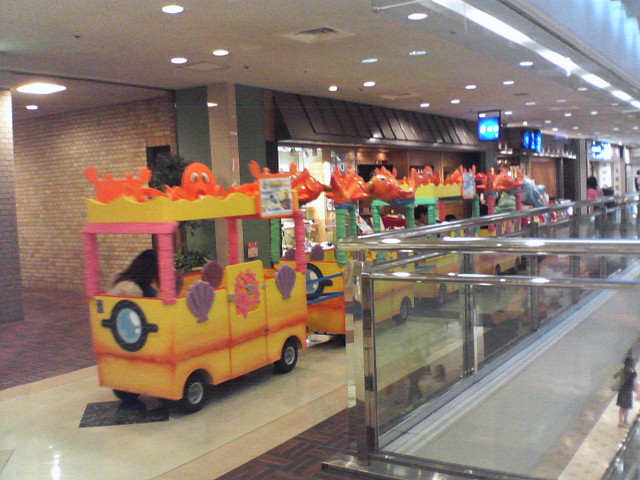
I went to the Sunshine City Mall in Ikebukuro today to look around. Sunshine City has four floors of shops, including a floor of nothing but restaurants. As is the case with most Japanese malls, the stores aren't all that interesting. You'll have much better luck finding neat, "Japanesey" stuff if you visit stores on any district's downtown streets, because Japanese malls are filled with the same GAP, HMV, and Eddie Bauer stores that we have in the west. In addition to the hords of clothing shops, there were also interactive events for small children in the mall (the main one was on the science behind typhoons). Here is a colorful deep-sea train that you could ride around the mall. The train played repetitive Disney-esque music as it crawled through the mall's crowded floors at a snail's pace. I enjoyed looking at the less-than-thrilled faces of the high school students whose part-time summer jobs required that they walk at five-paces per minute in front of and in back of the train to safeguard the human cargo, while being subjected to the same bubble-gum music over and over again.

Here is Restaurant Bambi in the Sunshine City Mall. I was hoping that it actually served deer meat, thus granting evil hilarity to the place's name, but it is in fact just regular Japanese food. Maybe you could ask the chef for some Bambi and Thumper though...if I were in France, you'd certainly be able to get it.

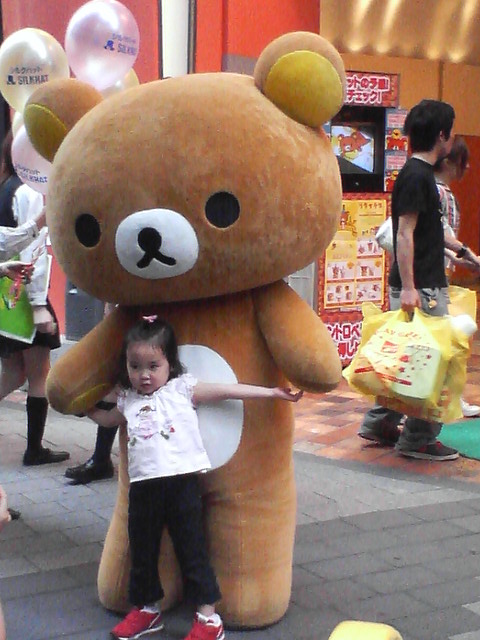
Here's a cute little Japanese girl posing with Rilakkuma the bear. This bear character is super popular in Japan, and is on all kinds of merchandise. In fact, Rilakkuma (be it male or female) just turned three years old!

They changed the display in the front window of Banpresto's headquarters near my house. Ban-Dai actually has many subsidiary companies (as one would imagine). They are all located within walking distance from my house, but unfortunately none have gift shops or are open to the public. Benpresto is the joint company between Ban-Dai and videogame developer NAMCO that does a lot of anime and game music projects with Columbia Music. The character you see in the picture is Gatchapin. He is a popular frog-like spaceship captain who has a slew of merchandise and TV spots in Japan.

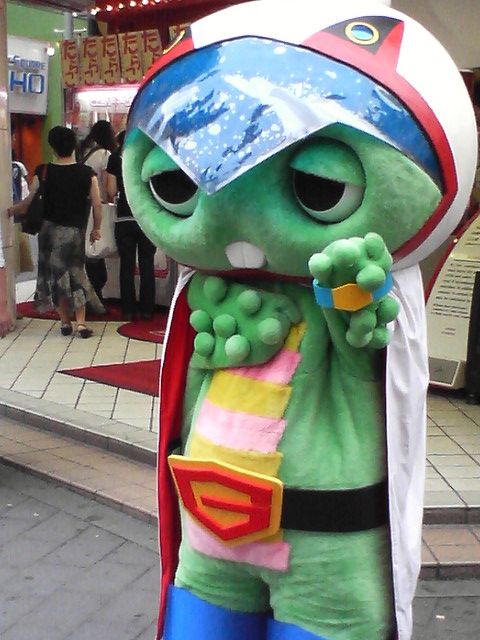
As I was walking through the streets of Ikebukuro, I got a chance to meet the real-life Gatchapin - it was quite an honor!

Here is Gatchapin's friend Mac who serves as the brains of the operation. You can tell he's smart by his white lab coat.

There's a delivery service about five feet from my housing complex. This is not one of the large Japanese chains like Takyubin or Pelican-bin, rather it is a mom and pop shop. The owners' two pugs can always be found laying in the front display window.

Friday, July 21, 2006


A giant origami crane in a storefront display window. Origami literally means folding paper in Japanese (kind of a no-brainer). I am unable to make an origami crane (or an origami anything for that matter) because I lack the patience necessary to get the job done right. When the folds don't line up, I make them line up by pounding my fists against the brightly colored paper as tears stream down my cheeks.

An entirely random but entirely appreciated emperor penguin display in the Ueno Train Station. Luckily for me, the Japanese and I see eye to eye with regard to penguins' supremacy in the animal kingdom.

Here is an automatic masturbating machine for those who fear carpal tunnel or just don't have the time to use their own hand. My sadistic side is envisioning the poor schmuck who gets his pecker stuck in the machine, only to have the varying speed knob break off once he's cranked the thing up as high as it will go.

Looking at the picture however, it strikes me that the best element might just be the English written on the free box of jelly that comes with the machine. It reads:

SOM Original Jelly For Your Ecstasy Up!
SOM's power's so great. But don't worry, this original jelly can wrap gently and protect you coz we put leaves of peach and aloe in it.

Wednesday, July 19, 2006

Happy First Japanese B-Day! 22 y/o 07/20/1984


Angels live among us. They walk and talk just like us, convinced that they are normal people. Perhaps after leading a normal life for so long, even they have forgotten how brightly their halo shines. If you are lucky, maybe you’ll get the chance to meet an angel in your lifetime. I met one tonight and am forever changed.This is the current Columbia Rose, Nomura Mina (there have been two previous enka singers who used the same stage name). I went to her performance tonight and ate dinner and drank with her and the concert staff members after the show - we all went to a Chinese place and had a good time. Getting the chance to meet her was an early birthday present. She is not only my age (well, a year older), but also the most beautiful Japanese girl I have ever seen. Pictures cannot do her justice, she is SO MUCH BETTER in real life. She is basically my dream girl on all fronts (looks, personality, talent, humor). We swapped emails at the end of the night. Don’t believe me? I’ve got the happy birthday email decorated with dancing teddy bears that I received from her at eight past midnight to prove it!

Monday, July 17, 2006


This is an installation piece at the famous Tower Records in Shibuya, featuring the artist Kimura Kaela (木村カエラ). Originally a popular teen model in Japan, Kimura is half Japanese and half British and is the largest J-Pop star at CME. I suspect that she is only fluent in Japanese however, judging from the horrid pronunciation of the English lyrics that permeate her new single. She is one of a new generation of cute female pop singer clones on the tier below that of demigods Utada Hikaru and Ayumi Hamasaki.

Her latest single "Magic Music" rose to number two on the national charts (it is currently at number seven having been out for almost a month now). Her style is much more rock / alternative than the aforementioned Japanese pop superstars. I have not met Kimura Kaela yet - this will happen when I transfer to CME's rock / J-Pop division in three weeks. The jacket art on her new album features the singer, sporting glittery wings, rising out of a multi-colored painted toilet. The toilet used in the shoot is on display at Shibuya's Tower Records so I had to take a commemorative picture - it is my company after all!

I asked a co-worker at Columbia about the toilet imagery. Sato-san said that for her latest album, Kimura wanted to give off a clean, happy and bright image. Pointing to the picture on the cover of a magazine, he said, "See, she comes out of here, the toilet right, but she is still so clean and happy!" He described this as "ii kanji" or a "good feeling" for the consumer.

This is Hikawa Kiyoshi (氷川きよし) the king of Enka music, Japan's #1 star, the Garth Brooks of Japan, and my company's pride and joy. I didn't know who this guy was before coming to CME and chances are that you don't either. If you have any friends who are Japanese however, ask them if they know who this guy is. Chances are they will not only KNOW him but LOVE HIM!!!

Hikawa's latest album "One Sword" debuted at #2 on the Japanese charts due to heavy competition from Utada Hikaru's new Ultra Blue (it is now #5 being over a month old). He also held the number one and two DVD sales slots for his music video compilations. There are Hikawa fan clubs all over Japan and you can see him regularly as a TV show guest personality. Unlike most enka singers who are popular only with the older generation, Hikawa transcends sales demographics as everyone seems to love him. Also, unlike most enka singers who wear kimono when they perform, Hikawa sings in modern and western clothing (though to me he often looks more like the flamboyant Chairman Kaga from Iron Chef).

As with my Bon Jovi sighting in the Sapporo Airport, I didn't recognize Hikawa even when he was five feet from my face. This was largely due to the fact that A) no one in the office made any fuss over him being there, and B) he looked very different - his hair was dyed brown and he was sporting fake fashion frames. Hikawa came into the office to say hello. My co-worker Mori-san pointed him out to me and I soon felt like a complete idiot considering that there were posters, cardboard cutouts, and little cubic pads of post-its with his image on it literally as far as the eye could see.

He carried around a little brown dog in a huge Louis Vuitton bag. I thought this was weird, but according to my host mom (who was visibly jealous when she responded to my bragging email) this is his trademark, and the dog I saw was actually the puppy of his older one. "OF COURSE HE HAS A DOG!" My host mother typed energetically. "THAT'S HIS TRADEMARK. I WATCHED THE PUPPY TAKE ITS FIRST STEPS ON NATIONAL TV!!!"

At the time, I tried to lower my head and avoid eye-contact with Hikawa-san so as to not meet him. He was to be the first star I would meet and I was very nervous at the time. Sure enough, however, I heard Shimura Bucho talking to Hikawa over on the other side of the room with me as their subject. Before long, Hikawa came over to my desk and I stood up. Egged on by the laughing staff of the enka division, he was forced to introduce himself in English. "Hello, my name is Hikawa Kiyoshi and I am a Japanese enka singer" was what he said. We switched to Japanese and he asked me if there was Japanese country music in the US and what I thought about the genre. He was overly apologetic for disturbing me, which made me feel bad because I had no real work to do.

His manager dropped the $40 deluxe copy of Hikawa's new album with the bonus DVD in my lap and said, "Here, listen to it," and walked away. Actually, Hikawa Kiyoshi's music was the only enka star that I had NOT heard up until that point, because they don't give his stuff away for free, so I promptly popped in the CD and began listening. It wasn't long before I was startled by Hikawa tapping on my shoulder to ask me what I thought of his music. I told him it was GREAT! I mean, what else can you say? Truthfully, I don't like his music as much as some of the other singers that I listened to (it is by no means bad), but as far as Japanese country music goes, they don't come any bigger!

Another picture of the music god himself.

This is Kobayashi Sachiko (小林幸子). Along with Hikawa Kiyoshi, she is one of the genre's top stars and has had a long and successful music career. Meeting her was somewhat like meeting one's new step mother. When I entered the dressing room, clouds of skin-tone powder were wafting towards her face, so she couldn't physically look at me. She apologized for her current appearance and said that all the people surrounding her dressing room chair had the daunting task of "making an old lady look beautiful again."

Her theatrical performance of her new single "The Fighting Flower of Edo" bordered on Kabuki as she struck dramatic poses on stage, snarling as she chopped through the air with makeshift karate moves. If you replaced her kimono with a dark dress and formed her hair into two opposing cones, she could have easily been Disney's Malecifent or Rita Repulsa from Power Rangers. I was told by my co-workers that Kobayashi-san has a photographic memory and that she knows the names of everyone who works with her, down to the lowliest tech person. We all followed her out to her limo as she left, because she was the biggest star from our company at the TV show filming. As the car was pulling away she rolled down the window and leaned out. She asked one of the many Japanese bouncers around the car dispelling fans, "What do the say in English?" "Goodbye" someone said. "Oh, right. Goodbye!!!" she said waving at me. And with that she was gone.

This is male enka singer Hosokawa Takashi (細川たかし). He sang his first number in a suit like this and his second number in a white kimono while tons of pink feather-clad dancers galloped around the stage like a Vegas show. Hosokawa-san didn't give me the time of day when I met him, but he didn't give anybody the time of day, so I didn't feel particularly bad. When I bowed and entered his dressing room, he was barking orders at his manager to get him some sweet-bean rolls from the snack room, and the glare coming off of his novelty-sized rhinestone studded west coast rapper's watch hurt my eyes.

Hosokawa mumbled 'nice to meet you' in my general direction, never looking me in the eyes. He turned to Shimura Bucho who always did my initial introduction and asked him where I was from and what I was doing there, never addressing me directly. Kaori, my 23-year-old friend and co-worker from the enka division was also there. Hosokawa-san turned to look at her and said, "You're Japanese right?" She nodded. "Where are you from?" Kaori made a joke, apologizing for the fact that she was from the boonies due to her hometown's location in Hokkaido. I laughed at the joke - it was cute. Hosakawa-san turned to Shimura Bucho and said with a dismissive laugh "OH, he understood that." I thanked Hosakawa-san for his time and left the dressing room.

This is 31-year-old enka singer Tagawa Toshimi (田川寿美), the third and final Columbia artist I met during the NHK TV show filming. She was very friendly (and VERY pretty - a fact that my male co-workers and I all agreed upon) but she cracked up laughing when I introduced myself using humble Japanese and apologized for wasting her time (she was being tied into her kimono when I met her which is why I apologized). Out of all the singers I watched perform during the show's filming, I liked her songs the best.

After the filming was over, all us record company head-hanchos (wink wink) stood in a line to bow and thank the artists and staff members for their hard work as they left the studio. Tagawa-san burst out laughing once again when she saw me bow to her and said with a laughing smile, "Oh, they made you do this too." I told Shimura Bucho that she couldn't stop laughing at me after the event was over. He told me that that is the way she is and to worry if she stopped laughing.

Here are the two members of the pop country group Tsukiyomi (つきよみ) - Takako (left-violin) and Ai (right-vocals). Can you believe that Takako is 28 and Ai 26? They certainly didn't look like it. They are the youngest artists on Columbia's enka label. Their music is different from most other enka singers in that it closely resembles our American pop country music industry and artists such as Shania Twain (Ai has a powerhouse voice and Takako's violin was very beautiful as well). I have listened to all of Columbia's enka artists, and I like them the best (I think it also helps that I have a crush on the singer).

I met these two before their outdoor concert in Shinjuku as they were applying makeup and doing vocal warmups. My guide for the event, producer Kurata-san (second under Bucho Shimura) instructed me to only speak English to the girls as a joke when introducing myself. As with all enka singers, he knew they could not speak a word of English, but that didn't stop Kurata-san from laughing at Ai and Takako's deer-in-the-headlights reaction to my English words. I handed out flyers around the concert area and helped push CDs after their concert was over using my super polite Japanese - I now know exactly how it feels to hand out kleenex packets on the street corner.

After we were all done, the girls, me, and Kurata-san, along with some random staff members who worked the show, went to eat at a place that specialized in cow tounge dishes (all expenses paid of course). Ai & Takako are the Japanese version of Penn & Teller. Ai may quite possibly be the fastest Japanese speaker I have ever heard, effortlessly stringing sentence after sentence together at lightening speed with no room for breath. Ai will make jokes about your dandruff or call you on sexual harassment, laughing hysterically loud one minute, only to launch into a detailed childhood story the next. Meanwhile, Takako would smile and silently eat her food, pausing every 10 minutes to check that her violin was still nestled behind her seat.

After dinner I rode home on the train with Ai and we got to know each other. It turns out, she would tell me, that she was very nervous during dinner due to the presence of the record label, which accounted for her flash grenade style of speech and biting jokes. From Chiba, she lives with her musician parents and has to travel around Japan a lot to do concerts to promote their group which she said is tiring. Her older brother just had a baby and she showed me pictures of the little guy on her phone. All in all, a very nice evening with very nice girls. Ai was in my dream that very night. I'm trying to get in touch with her again to hang out...we shall see how that goes.

Another picture of Tsukiyomi's Ai (left) and Takako (right) - I don't know who the girl in the middle is because I grabbed this picture off the web. This is more how the two of them looked when we all ate dinner together.

This is the 28 year old Yamamoto Satoko (山本智子). She was to be the headliner at the 16th Annual BBQ and Raft Race that I attended at Izumi-Tamagawa on Sunday with my coworkers; however, I didn't actually see her perform. Rather, she just hung around our tent area and ate food. She was very nice when I met her but talked with a high pitched school-girl accent that got somewhat annoying.

She really liked my cell phone strap and kept playing with it and telling me how adorable it was. She also couldn't keep her hands off me (most likely due to the fact that she was very drunk - I was very drunk too). She put her arm around me and rubbed my stomach and whenever she wanted to talk to me, she would move her face very close to my face call me "Ben-chan."

I Think I'm Turning Japanese (研修スタート)!

Bet you were wondering when I was going to sell-out and use that as a title. Because I have a lot to say, this first post will focus on the work world in general, while my next post will focus on the specifics of what I have been doing.

While I have just now only completed my first week of work in Japan, my recent home-stay in Kyoto could not seem farther away. I arrived at Columbia Music Entertainment (CME) on Monday morning at 10 AM and met up with one of my 10 bosses, Okuno-san, the head of personnel. We took an elevator ride to the 10th floor and sat in a small meeting room with clear glass walls. It was evidently the 10:15 AM feeding show in the Gaijin pen, judging from how many Japanese people stopped dead in their tracks to stare at me. I smiled and waved as I signed release documents with my feet.

I soon received a magnetized keycard that was to let me into the building and all of the offices, but promptly discovered that it didn’t work when I was locked outside of the building, madly swiping my card like the world’s worst secret agent. My chipper Japanese helpers on the 10th floor would later reactivate my keycard and apologize profusely. I also received a Dell Inspiron laptop (running a Japanese OS of course) to do any and all of my work on.

The hanko name stamp that was created for forming my bank account (an account that currently only has 16 Yen in it) was an instant hit at Columbia. I had to use it in the glass walled room with Okuno-san to verify tons of pieces of paperwork. After word got around, Japanese coworkers of all shapes and sizes requested to see it - laughing, studying, and staring at the characters on my stamp as though it featured markings from an alien spacecraft.

Okuno-san gave me a repeat of the same company history lecture that he gave me when I visited several months ago. Founded in 1910, CME is the oldest recording company in Japan and responsible for fostering the nation’s domestic recording industry. CME is NOT affiliated with Sony Music Entertainment. Ironically, Sony owns the rights to the name Columbia Records in every country except their home turf of Japan. Today, CME has divisions that specialize in JPop, jazz, classical, anime and film music, enka or country music, and children’s music. Currently, enka is the most profitable division followed by anime. CME also does a fair amount of distributing DVD box sets of American and British music and releasing independent foreign films on DVD within Japan as well. Their latest film is a piece of Mongolian origin called “Heaven Land.”

Regarding my internship, I will be spending two weeks in the enka division, two weeks in the anime / film division, two weeks in the studio / production division, and finish up with two weeks in the marketing division, before giving some sort of hour-long presentation to the upper management of the company in Japanese.

I am not too worried about this presentation as I have already met the president and all the upper management of the company and they know me by name (I guess it is not that hard to spot the one white person in the company). The president is a visible figure who walks around and pops into the different offices to say hello. He is fluent in English, but the two of us only ever speak Japanese. He told me that he has a son my age who will be traveling to do a study abroad and internship program in New York next year. He told me, however, that his son refuses to speak and study English, and that when he tells his American host family that his father is the president of Columbia Music Entertainment, it will “bring shame to the company.”

Okuno-san and I ate lunch at a nearby fish restaurant – he treated. In fact, I didn’t pay for a single meal this past week while at work. Japanese people are usually afraid that you won’t like their food, so they are always put at ease when I tell them (and make good on the fact) that I will eat anything they give me. So as to gauge whether or not they will be dining opposite someone who will soon create a scooping motion with their three extended fingers while silently mouthing the word “F-O-R-K,” there is always a series of questions from your Japanese colleague as you approach the dining establishment. I always answer yes to all these questions, so I don’t know where the conversation goes if you take the blue pill.

1) Do you like Japanese food?
2) How about raw fish? Is that okay?
3) How about umeboshi (pickled plum)? You won’t eat that!
4) How about natto (fermented soybeans)? You couldn’t possibly like that!

Umeboshi and natto represent what Japanese people believe to be the most trying items for the Western palette. While eating, Okuno-san drew a large square on his napkin to represent the state of California and then created a series of subsequent smaller squares inside the bigger square to represent regions within the state. I stared at the baffling diagram and pointed to a northern square when asked and told him that that was Stanford University. He nodded energetically, pointing to his squares, saying, “Right! Right! knew it was there!”

As we entered the building after lunch, it was time for me to sit at my desk. My desk is located on the eighth floor which houses the enka and anime divisions. I received the vacated desk of Honda-san who was forcibly removed by Okuno-san. I started apologizing to Honda-san as Okuno-san busied himself by scooping up the older man’s belongings and putting them in a cardboard box. Honda-san grumbled as he moved to the other side of the room.

More musical chairs were in order when Boui-san (pronounced “boy” in Japanese – a fact that led her coworkers to turn to me and chant in English “notta girl, notta girl”) moved to the desk across from me. And then, the main event, a white boy with his shiny silver Dell Inspiron laptop takes his seat at the now empty desk and the circle is complete. I’m sure this is the most excitement the office has seen since the compact disk was introduced.

The Japanese work in a pyramid-style team structure. Each division has a bucho or section leader who is responsible for overseeing all the employees underneath him within the division (around 20 people in the enka division). Each bucho is in turn responsible to a kacho or greater division leader. The kacho are responsible to the management, and the management is responsible to the shacho or president. There you have it, a simple pyramid.

Work in Japan is being in an environment that best facilitates the group or team structure. My enka division contains two giant tables that run the length of the 150 foot room. Everyone has a place on the table, with neighbors on each side. There are no cubicles, no walls, and no privacy. You hear your neighbor when they talk on the phone or hum along to the new album they are listening too. The Bucho sits in a floating island table in between the two larger tables and his right hand man (the next highest in command within the section) sits next to him. My current boss is Bucho Shimura-san of the enka division, a short and stout man in his late 50s with glasses and a habit for chain smoking all hours of the day. He waves his hand at me when he wants me to come to his desk and speaks with a heavy Tokyo accent that uses “saaaaaa” every other word. “Saaaaaaaa, Ben, OK saaaaaaaaaaa, I’m gonna need you to saaaaaaaaaaa type this into the saaaaaaaaa computer for me saaaaaaaaaa.”

And now for a few observations about the Japanese workplace:

1) How much do YOU actually work?! In case you don’t know, Japanese people routinely work overtime. This is a characteristic of business in Japan. In many cases this includes coming to work at nine in the morning and leaving at 10 PM at night or later. Indeed, during my first two days at work, I was working live music events and didn’t get home till past midnight. Oftentimes there is an unspoken cultural-based sense of obligation that one must not leave the office until the Bucho has gone home for the day.

What one finds despite these insane hours, however, is that Japanese productivity, while very high by world standards, is not that much more efficient than American productivity or Korean productivity for that matter. This is due to the fact that Japanese people do not really work 100% of the time they are in the office. I would best describe the atmosphere of my office as a permanent sleepover. People walk around, visit friends on other floors, gossip at the coffee machines, and crowd around someone’s desk to watch a funny internet video off of YouTube. When your body gets tired, why not stand up and do calisthenics in place. If you are bored, whip out a personal MP3 player or game machine to pass the time. This is the type of office I commute to everyday.

2) These people are your family! Many Japanese businessmen will see their company team members more than they will see their actual family. A colleague of mine that I was privileged to drink beer with after the NHK TV show filming I attended told me in English (he was practicing English at the time due to his lowered inhibitions from massive alcohol intake), “My job is devil.” He held his fingers up against his head to create pointy devil horns. When I asked him why he felt this way in Japanese, he told me that he has a wife and two kids (ages 7 and 10), but never gets a chance to see them. He told me that there is only one night a week where he gets home before 11 PM at night. He went as far as to suggest that we should go drinking again on that night. I told him he should go home and be with his family. A Japanese businessman wakes up, goes to work, goes home, sleeps, and does the whole process over and over again.

3) If you don’t have any real job, chances are that nobody else does either! Spending nine hours in front of a desk with nothing to do can get boring. There are only so many times you can check your gmail account or rearrange the Hello Kitty writing utensils in your desk drawer. At first I busied myself with listening to CDs and watching music videos. One of the bonuses about working in a recording company is that they have boxes and boxes of free CDs. Thusly, I have now listened to a full CD from every single enka (country) singer that is on my company’s label. I have also watched several music DVDs as well.

I emailed Shimura Bucho in the middle of the week and politely asked him to put me to work. Nobody in the office seemed to have any problem with the fact that I had nothing to do up till then. As a result of my email, the following day had me hole-punching and stamping budget documents. If this were all I did on a daily basis, I would be pretty upset. Luckily for me however, my job has a whole different side once the sun goes down. You will have to wait for the next post to hear about this!

4) Everyone wants to pet the gaijin dog! Being the first and only internship student that CME has ever had, in addition to being the only white person in the 12 floor office building, I am a visible misshapen peg. I am blessed with the fact that everyone speaks to me and that I function completely in Japanese at work (actually, no one in my current enka department speaks English). I am also blessed with the fact that as the new gaijin pet dog, I have tons of people who want to rub my belly. My dog bones and chew toys come in the form of all expenses paid lunches and dinners nearly everyday, any and all free CDs and merchandise I want, and the opportunity to interact in the entertainment industry on a level that most people never see.

Many coworkers will make time to come and visit my desk everyday, just for the chance to talk to me in Japanese and get to know me. My movie producer friend from Ban-Dai Entertainment brought me a bag stuffed full of limited edition Playstation 2 games, DVD movies, and soundtracks all because I told her I like giant robots that fight each other. I tried to humbly refuse the gift as best I could, but she insisted, saying, “I have tons of this stuff and don’t have any need for it.”

-------------------------------------------------------------------------------------

I have so far found my Japanese work environment to be extremely friendly and welcoming, especially given the fact that I am a complete outsider and that the company doesn’t really gain anything tangible from me being there other than cultural exchange. Rather, I am the one with unlimited gains as I get the opportunity to learn, experience, and operate within a Japanese entertainment business environment. I look forward to coming to work at CME everyday (though I hate riding the packed morning train) and I can’t wait to tell you all about the real fun I have been up to next!

Stay tuned!

B.E.W.

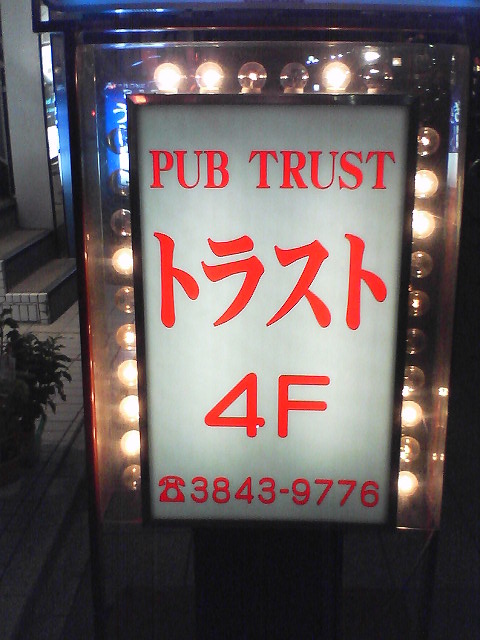
My friend and I had dinner tonight in Shibuya and finished the evening off with a trip to a nearby pub. How can you resist Pub Trust?

Here is the absinthe cocktail I ordered at Pub Trust. It was prepared in the traditional style, by grinding a sugar cube up into the green liquor mixture. Illegal in the United States, absinthe is said to contain anywhere between 60 to 90% alcohol. While I can't vouch for the ratio in my drink, judging from the fact that the bartender poured the liquor out of a plastic jug from underneath the bar counter, I have a feeling that I got the real stuff. The Japanese menu, alluding to the drink's taunted hallucinogenic properties, had the phrase "drink your marijuana" written in green kanji characters. The cocktail was certainly strong, but no different for my tounge than drinking anything mixed with Bacardi 151. I certainly didn't feel stoned, or even especially f'd up for that matter. If I am still conscious during the train ride home, then it's time for a stronger drink!

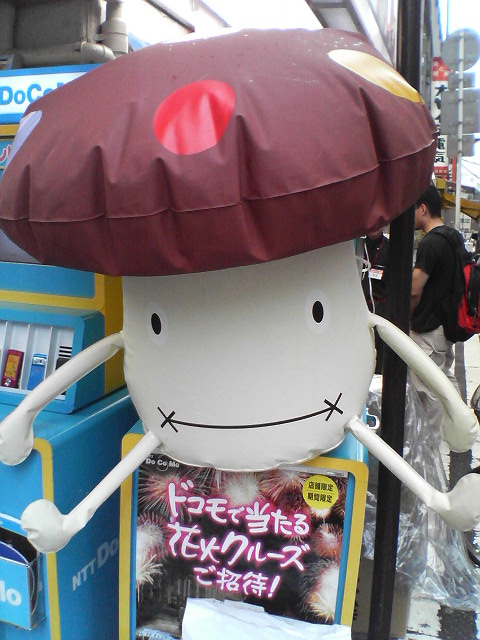
Here is a giant Docomo-dake. DD is the mushroom mascot for NTT Docomo cell phones (the largest cell phone provider in Japan and my personal cell phone provider as well). He is very popular nowadays and is on my cell phone strap. The word "dake" can either mean mushroom in Japanese or "only." Thus, the character's name can also mean "Only Docomo."

Sunday, July 16, 2006


Here is the entrance to the omatsuri or festival that I went to on Saturday night. An omatsuri is basically like a giant street fair, with all sorts of booths that sell fried foods, sweets, and games of chance at highly inflated prices. It is customary to wear kimono and yukata to omatsuri, especially in the summer when it is super hot and humid. While I didnit get to wear mine, I did see lots of pretty Japanese girls decked out in beautiful kimono with their hair done up in 10-foot tall vertical sculptures. You can see that there were spotlights in the background of the picture. At one point during the evening it started to rain and you could see the individual water drops flutter down through the powerful white light. Of course, my camera failed to capture the beauty of the illuminated rain, but take it from me; it was an image straight out of a Disney fairytale.

I like that the Japanese people in the foreground of the picture are motion blurred. I didn't intend for this to happen, but I think it gives the picture a very nice dream-like quality.

The warm glow from the walls and walls of lanterns.

Here is my ayu fish on a stick that I bought for a snack at the festival. You eat it bones and all. Beats corn on the cob any day of the week!

One of the many Condomania stores throughout Japan that specialize in selling every type of condom you can possibly imagine. There used to be vending machines called "Family Planning" that sold condoms on the street in Japan as well, but I suspect they were all put out of business by these contraceptive superstores. No one ever thinks of the little guy.

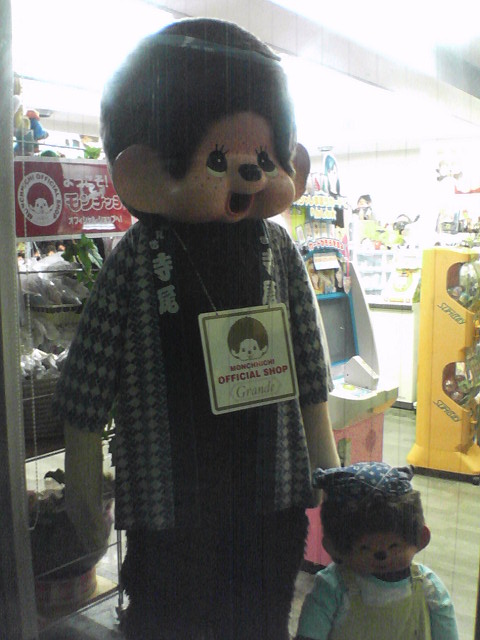
Here is a giant life-sized Monchichi with Baby Monchichi. Monchichi is a somewhat creepy somewhat cute half-monkey half-human character that adorns all sorts of merchandise in Japan.

Saturday, July 15, 2006


RUN FOR YOUR LIVES!!! GODZILLA IS ATTACKING THE CITY!!! Just kidding. When you stop and think about it, it seems only natural that the Japanese would erect a statue commemorating their favorite city stomping lizard. This statue is found in the Ginza area of Tokyo where Godzilla first ran amuck in his 1954 movie debut. A plaque is attached to the statue with the phrase 「最後の一匹とは思えない」or "I don't think we've seen the last of him." And now, a brief note on the etymology of the name Godzilla. Godzilla is the English translation of the lizard's original Japanese name "Gojira." Gojira is actually a combination of two Japanese words; "Kujira" which means whale, and "Gorira" which means gorilla. There you have it, the "gorilla whale." "Gorilla" alludes to the massive size and strength of the beast while "whale" pays homage to his home in the sea.

RUN FOR YOUR LIVES!!! GIANT SPIDERS ARE ATTACKING THE CITY!!! Just kidding. This large spider statue is found near the decadently expensive and luxuriously designed Roppongi Hills shopping and business complex near where I work.

A unique way of using manikins to advertise pants.

Friday, July 14, 2006


A video of me conducting my electronic dildo symphony. The music in the background is actually coming from the store.


There is a large outdoor fish tank on Roppongi's main drag. I stopped to take a quick video of my favorite huge and colorful fish!

A restaurant I passed in Iidabashi is home to the world's biggest gyoza (potsticker). You can actually order this dish for around $150 - It feeds a small nation. I find myself drawn in by the massive dumpling's hypnotic powers and unable to finish thi...

Here is a picture of my train line on the ride to work (for comparison). Blurry pictures like this cannot possibly capture the feeling of being engulfed in a mass of people. It is awful I can assure you. The average Japanese businessman does this communite TWICE EVERY DAY!