Monday, August 14, 2006


HOLY CRAP it's Psychic Lover! I originally had a different caption for this picture when I published it yesterday, and didn't even notice it was them until I looked at the picture again this morning. Now I understand why there was such a big crowd in front of them snapping furious pictures. The maid with the orange-ish hair in the middle is Jo and the one with the black bonnet next to him is Yoffy.

Look who I ran into! The man himself, Hayao Miyazaki.

They can make coffee for me anytime!

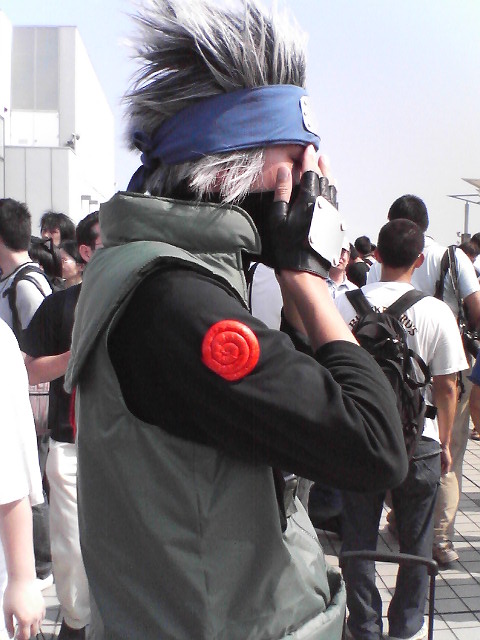
One cosplayer wipes the weariness from his face. It must be tiring to walk around all day looking like a complete idiot.

Meeeeeeeow!

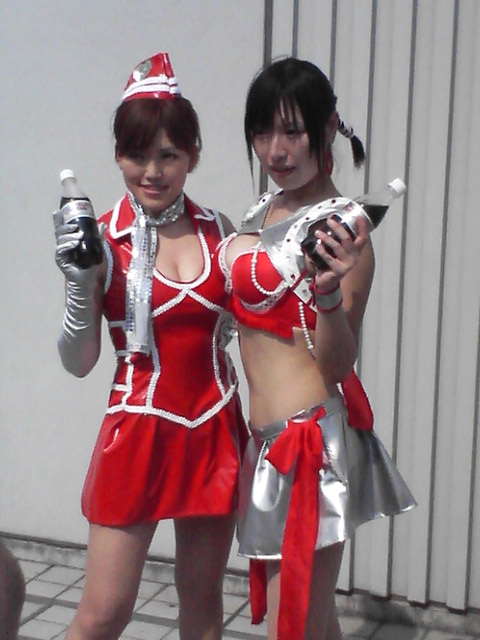
I'll have a Coke!!!!

Sunday, August 13, 2006

Living the Dream: Part I – “This is a pen”


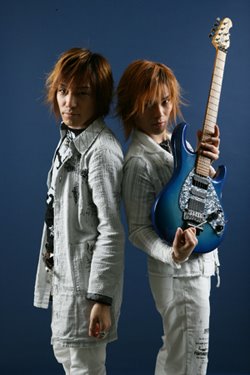
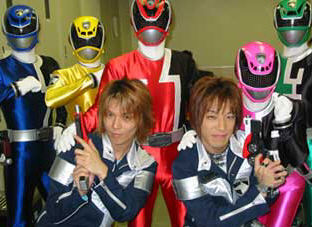
¥1000 says you have never heard of them. Their name is Psychic Lover (サイキックラバー), and I spent my past two weeks in the anime division hanging out with them. The guy on the left is Yoffy (pronounced yoh-fee) and the guy on the right is Jo (pronounced Jo). Both guys are 29, though like every Japanese person, they certainly don’t look that old. Yoffy is responsible for the band’s name, and is the composer and lead vocalist for all the duo’s songs. Jo works on lyrics, provides backup vocals, and shreds through wicked guitar solos.

Psychic Lover is one of the biggest names in Japanese anime music. They have written theme songs or supporting music for Power Rangers, Witchblade, Gaiking, and Transformers (among many others). Their most recent single is the ending theme for to the current Power Rangers series in Japan, Go Go Adventure Rangers (轟轟戦隊ボウケンジャー). Their song, entitled “On The Road,” rose to number 14 in the Japanese singles chart, an unprecedented feat for an anime song not associated with a Miyazaki film.

I would describe Psychic Lover’s musical style as an upbeat pop-rock. While their stuff does definitely sound like anime music, there are enough overdriven guitar solos to keep rock fans happy. Also, since every song features a very catchy and upbeat chorus, you’ll be humming the tune upon repeated listening. For those interested, Psychic Lover’s album was released in June of this year and is entitled, you guessed it, “Psychic Lover.” The album contains all of the duo’s hit singles (including the new Power Rangers theme) and is readily available on amazon.co.jp. I highly recommend it, and not just because I’m friends with the guys.

I met Psychic Lover at Tokyo AM radio as they prepared to participate in a short promotional program (i.e. they were signing tons of release forms and couldn’t do anything but bow and say “hi”). I have taken many pictures with Yoffy & Jo, and they said they would add me on their internet blog (I’ll provide a link when this happens). I messaged Yoffy on my phone and asked him to forward me pictures of the three of us together, but he hasn’t forwarded me any yet, hence the stock photos.

Yoffy and Jo were participating in a pretty average Japanese radio program. Japanese radio stations often feature short twenty minute shows with actors, musicians, and other social celebrities who banter comedic dialogue back and forth (comedic if you’re Japanese that is) and introduce the songs that the radio station is currently broadcasting during that half hour block. Think of these guests as celebrity DJs. In turn for hosting, the artists get to plug their latest product and upcoming events a million times on the air.

This radio station visit was considerably more relaxed than the previous trip with my enka colleagues, where I was hit on constantly by a gay Japanese man. Sakamoto-chan, as he calls himself, was a 22-year old, head-shaven, designer glasses sporting college student (I didn’t catch his major), who became a radio personality sensation thanks to his unique ability to mimic the voice of a perpetually startled, chain-smoking Japanese schoolgirl.

He squeals phrases like “You are my everything,” on the radio complete with the female-specific suffixes (there are male-specific suffixes as well in Japanaese). When I first met Sakamoto-chan, he jumped straight into, “You’re cute,” in lieu of a personal introduction, and asked me if I liked boys, only to sigh under his breath, “You probably like girls huh?”

But I digress...

I spent most of my pre-show time at Tokyo AM talking with one of my new love interests, Nana. This makes three possible soul mates now. Rose, baby, if you’re reading this…then wow, you certainly got talented in English quick! Hahahahaha. Sorry, stupid joke (lowers head).

Nana is my age and works for the radio station (she just graduated college). She also went to high school in America so she could speak great English (though we spoke ¾ of the time in Japanese). Nana is a second-tier DJ. She was honest, however, and told me that she really only reads that line at the end of the broadcast that goes, “The proceeding program was brought to you by Fukamoto Whale Blubber, Tofu-a-Go-Go, Discount Samurai Swords and listeners like you!

I watched Psychic Lover do their show – Nana was in the hot seat right alongside them, though she didn’t say much. The three of them were provided with a script of all their stupid jokes and banter, but were encouraged to improvise by the director in the sound booth. I laughed at a few jokes which were pretty funny (due mostly to the overenthusiastic delivery of Yoffy and Jo who were reminiscent of a really bad standup comedy routine).

Occasionally, someone would mess up and everyone would pause and retry a bit multiple times. One bit had to be rerecorded several times until Jo could successfully say with a straight face that he pretends to fall asleep on the train in order to rest his head on the shoulder of the lady sitting beside him. This is the kind of humor that had everyone in the sound booth (except me) wiping tears of laughter from their eyes.

Psychic Lover’s Director, Mizuhara-san, showed up after the recording process was done and his boisterous presence was almost impossible to ignore. Mizuhara-san is a big man, over six feet tall, with enough fat mass attached to his bones to give him an imposing, jiggly presence. He wore a black suit, had spiky short hair, and wiped sweat from his brow with a purple washcloth. There will be much more on Mizuhara-san later, but believe me when I say he is a true character.

Mizuhara-san knew Nana from previous dealings with the radio station and, as she and Psychic Lover left the recording booth, he immediately told her that he could see her underpants. Nana frowned, joking it off, and would tell me later in Japanese that workplace sexual harassment is still a big problem in Japan and that she doesn’t like Mizuhara-san for precisely this reason. I can’t say that I blame her.

After introducing myself, Mizuhara-san said, “I English genius!” repeatedly in America-speak. After tiring from overusing that set phrase, he proceeded to repeat “Look, I’m Stanford,” “Look, I’m Stanford” in English while miming typing on a computer or tapping himself on the noggin with his tongue hanging out. He kept prompting me to tell Nana that her English was horrible, but I refused, and defended her until he was interrupted by Psychic Lover asking me to read some of their English song lyrics with my native pronunciation.

I read the lyrics and was treated to ooohs and aaaaahs and a round of applause. The Japanese people in the room took turns telling me how good my English pronunciation was. I told them that I had been studying English for 22 years, so they shouldn’t feel bad.

As Psychic Lover, myself, and Kubota-san (my anime section coworker and Psychic Lover’s representative from Columbia) were readying to go to our post-recording kanpai, the radio station was flooded with young female voice actresses from radio shows, CD albums, and anime programs, all lined up to participate in the next broadcast. This delayed our departure by a few minutes, as all the girls wanted to giggle and fawn over Psychic Lover.

All of said voice actresses were sugar and spice and everything “gag me with a spoon” nice. One easy-to-remember voice actress was dressed in a full bubblegum pink-colored track suit with bright green Converse shoes and her hair in tight pigtails. “She is very very adorable,” Mizuhara-san said, pointing to her as she practiced blowing kisses on the couch, despite there being no one to receive the kisses in front of her. She was able to get out, “Hello my name is_____” during our meeting, followed by, “I love you!” and assorted giggles. It was all I could do to bow without upchucking my lunch. Death by cuteness; I guess such a thing really does exist in Japan.

Much to my disappointment, Nana was unable to come to dinner with us. I tried my best to persuade her to come but she said she had another engagement.

Psychic Lover, Kubota-san, and I went to a nearby yakitori or skewered assorted meat parts restaurant (it is not that bad when you wash it down with crisp, cold Asahi Super Dry!). Our waiter was super energetic and would fire punches off and say “OKAY” in English whenever anybody ordered.

What can I say, Psychic Lover are really fun guys. All smiles, not only were Yoffy and Jo both super friendly, they seemed genuinely interested in talking and getting to know me.

Yoffy asked me which of the girls I liked the best at the studio and I of course answered Nana. He proceeded to message her from his phone on my behalf, and snag her contact information for me saying, “Nana is free.” The two of them loved the fact that I could speak Japanese and would gasp in awe when I told them about the different Japanese foods I eat or that I had been to a maid café.

As we all drank more, the Japanese side began attempting more English and I attempted to keep my Japanese intelligible after repeated glasses of booze. Kubota-san, who had traveled to Australia and America, asked me questions in English about American culture or my family and I would answer him in Japanese. This dual language exchange brought Jo nearly rolling on the floor in laughter. While Yoffy said he had been to Hawaii once, Jo has never left Japan.

Though they use a lot of English phrases in their lyrics, it is fair to say that Yoffy and Jo don’t speak English. Yoffy told me that he came up with the name “Psychic Lover” and asked me what it meant in English. At the time, I said that it didn’t really have a meaning, but retrospectively, I guess the band’s name could refer to someone who can psychically predict and fulfill one’s sexual and relationship desires. I think that much would have been lost in translation had I attempted to explain it in Japanese.

Jo asked me to explain “l” and “r” sounds to him since Japanese people don’t have these sounds in their language. I always use the example of “lice” versus “rice” to illustrate the pronunciation differences. Jo told me that all Japanese people study English starting from middle school starting with the phrase “this is a pen." He explained to me that there is a song you listen to in middle school with the lyrics “this is a pen.” Thus, Yoffy and Jo began singing, “this is a pen – a pen – a pen. This is a pen – a pen – a pen” in unison while swinging their chopsticks back and forth. Before I knew it Kubota-san had joined in and I figured I might as well fill in the harmony.

There we were, the four of us, laughing and singing like idiots about ball point pens in the middle of a hole-in-the-wall drinking place in some corner of Tokyo. Though the drinks and food orders stopped soon after...“this is a pen” would linger on through the night air.

To Be Continued...

B.E.W.

Part II - "You GOT IT!!!"


Here is an arcade game where you chuck plastic balls, like those you'd find in the McDonald’s Play Place ball pit, at a video screen and try to hit targets. Fun for the whole family! Watch the dad on the left, he's really getting into it; Randy Johnson LOOK OUT!

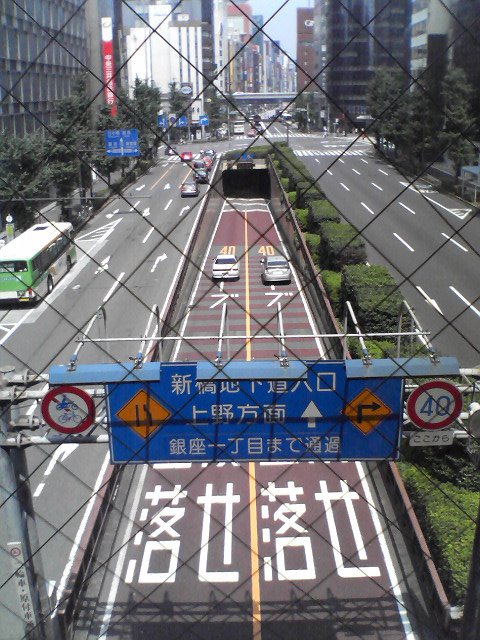
My anime section coworker and I couldn't figure out if this was the tunnel where they filmed the motorcycle chase for Kill Bill: Volume 1. What do you think?

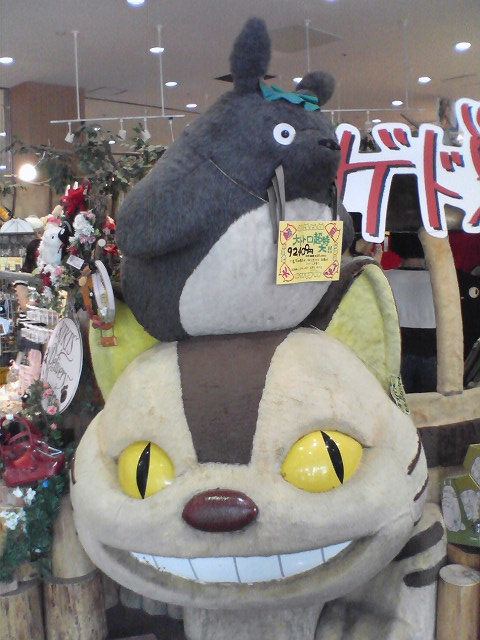
A neat storefront display with a pretty lifelike nekobus from Tonari no Totoro.

Saturday, August 12, 2006


It’s a guarantee that even the newest mobile phones on sale in the west are light-years behind what they have in Japan. With 4 mega pixel digital cameras, mp3 players, internet browsing, and videophone all standard nowadays, the latest must have feature is the ability to watch live television on your phone. While earlier phones did in fact let you watch television, only this generation makes use of the new digital network for crystal-clear picture and sound.

My service provider DoCoMo released their TV phone around the same time I arrived in Japan. Here, however, is the newest and coolest mobile phone to hit the market in Japan made by competing company Vodafone. Watching TV on this bad boy will only set you back $350 or so.

And the super special secret feature is? Well, you’ll see…

B.E.W.

P.S. – I am sorry it has taken a week for any movement on the blog. I have been busy and out till late as usual in my new, less-than-stellar, sales department. On top of that, I recently caught a cold and feel pretty crummy to boot. I have some really good stuff coming though, including the start of my “Living the Dream” series of posts. Stay Tuned!

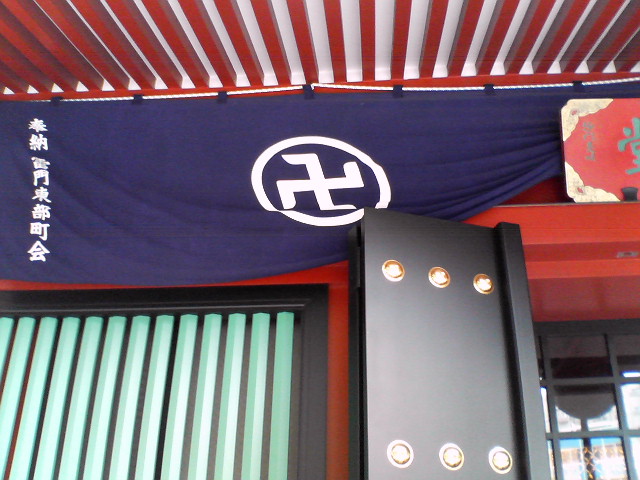
As I was walking my usual route to the train station this morning, I spotted this at a small street-corner temple. You'll notice that it is a backwards version of the Nazi Swastika. This symbol that the Nazis manipulated actually comes from China. While not used in Japanese writing, this character will occasionally adorn signs or buildings in a purely as decoration. Certain Jewish social groups protest in Japan (and other Asian countries) against the use of this decorative symbol due to its proximity to the Nazi insignia.

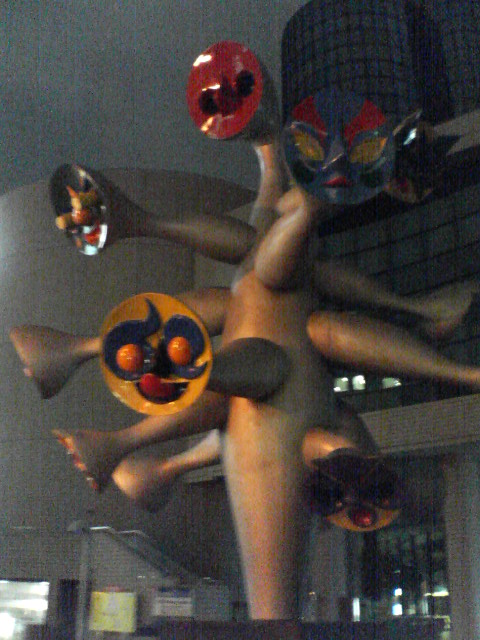
Here is a sculpture that caught my eye on the streets of Aoyama (near the public library and Aoyama University). It kind of reminds me of the type of boss you'd battle in Zelda.

Wednesday, August 09, 2006


「これはペンです。通じる?」 ~ ジョー

Monday, August 07, 2006

Yasukuni Shrine (靖国神社)

Below you can see pictures from my trip to Yasukuni Shrine (靖国神社) – literally “peaceful country” in Japanese. Located about 20 minutes from where I live, Yasukuni Shrine continues to be a politically charged, controversial site.

Originally built in 1869 by the Meiji Emperor to commemorate those who died in the Bonshin war (1268-69) between the Tokugawa Shogunate and pro-imperial forces, Yasukuni Shrine has now come to be Japan’s wartime memorial, enshrining those who have died for the emperor in past wars.

As of 2004, the Yasukuni Shrine Book of Souls lists the names of 2,466,532 people who are enshrined at the site. This is a symbolic enshrinement of one’s soul; no actual bodily remains are kept in the shrine. Of these 2,466,532, 15 members were convicted of class-A war crimes in the Tokyo war tribunals following WWII.

Prime Minister Junichiro Koizumi visits the shrine annually and pays his respect to Japan’s fallen war heroes. Just last week, the current frontrunner in September’s prime minister race, Shinzo Abe, visited the Tokyo shrine as well. However, the Emperor of Japan ceased visiting the shrine in protest after the class-A war criminals were enshrined in the postwar era.

Whenever a Japanese politician visits Yasukuni Shrine, citizens in Korea and China protest and demonstrate in the streets. They believe that these visits are evidence of Japan’s revisionist war history and a lack of remorse over colonial rule in China and Korea, and wartime atrocities such as the Rape of Nanking.

I trudged up a hill leading to the shrine grounds, sweat pouring down me due to the 96 degree sun. I was not alone. I passed a line of parked tour busses that ran the entire length of the hill. These days, Yasukuni Shrine is one of Tokyo’s main tourist attractions due entirely to the political controversy that surrounds the site. Yasukuni Shrine was no different from any of the shrines and temples I visited in Kyoto; There was an ablution pavilion to clean your hands and mouth, an alter where you could donate money and pray, a garden that displayed beautiful flower arrangements, and vending machines as far as the eye could see.

Next to the shrine is the Yasukuni Shrine War Museum; Japan’s premiere wartime (revisionist) history museum. The museum was indeed a patriotic and nationalistic look at Japan’s involvement in wars and global conflict. I would not say that the museum is revisionist, because the exhibits do not deny or revise painful historical events. Rather, I would say that the museum is excusionist. That is, the museum seeks to justify (often with very thin logic) and give excuses for why Japan acted the way it did in many global conflicts.

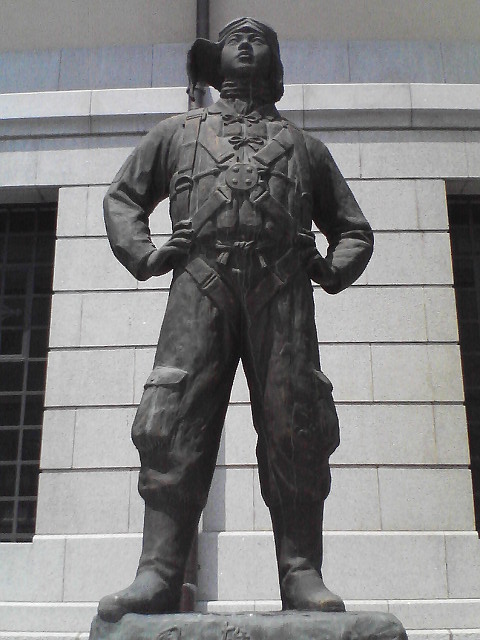
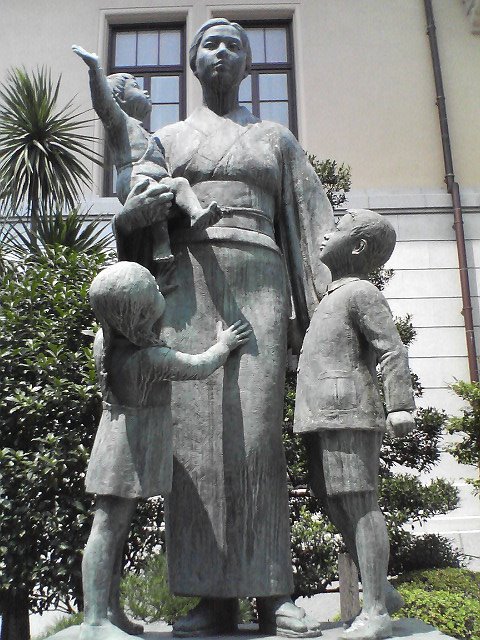
The courtyard outside the museum had a statue of a young bomber pilot striking a gallant pose, while another statue was a mother cradling her “children of Japan.” Statues inside the museum depicted a lone Japanese soldier, while another showed a platoon of wounded friends lending each other a helping hand. Are these statues overly patriotic? You bet! Are they any different in tone from the “Iwojima Memorial” statue in Washington DC? I personally didn’t think so.

The museum has numerous showrooms with replicas of wartime bomber planes, artillery shells, gun turrets, tanks, and weaponry. More interesting however, are the quotes that dangle from the ceiling on giant illuminated plaques that ask soldiers to die for the emperor and possess the yamato (samurai) spirit.

Showrooms in the museum also take the visitor through each of Japan’s major conflicts. One room presents information about colonizing Korea and Japan’s “desire to see the country liberated.” Plaques leading up to the wall-length panel on the Japanese attack on Pearl Harbor discuss Japan’s dire economic situation, and a map shows how foreign nations (represented by colorful arrows) were all encroaching on Japan’s backyard.

Moreover the notion of denying Pearl Harbor or prewar imperialism, I would say that the Yasukuni Museum seeks to present excuses for why Japan acted the way it did and asks the visitor to sympathize with the country, asking “what would you have done if you were in our shoes?” Whether you choose to sympathize with the Japan that is presented in the museum is entirely up to you. I don’t. Japan did a lot of very horrible things in the world, this much is clear. But, Japan has also been an entirely peaceful, socially minded, beneficial contributor to the world community for over 60 years now. While it is important that we never forget history (or be doomed to repeat it), we must also believe in and look towards the future and respect that people and the times can change.

It seems to me that these days, too many people and too many nations are presenting excuses and evoking past sympathy to further their own private aims and conflicts. It’s up to everyone to individually weigh the facts, make their own decisions, and fly their flags in support respectively, be they protest leaflets or votes. Don’t let a war museum or the latest headline on the six o’clock evening news tell you what to think. Research the facts and make up your own mind; that’s what free citizens are supposed to do.

B.E.W.

Sunday, August 06, 2006


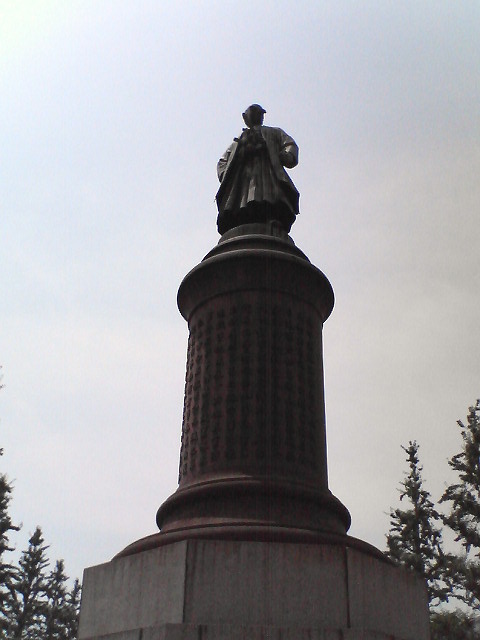
A statue of a Japanese wartime general that marks the entrance to Yasukuni Shrine proper. IKUZO!!!

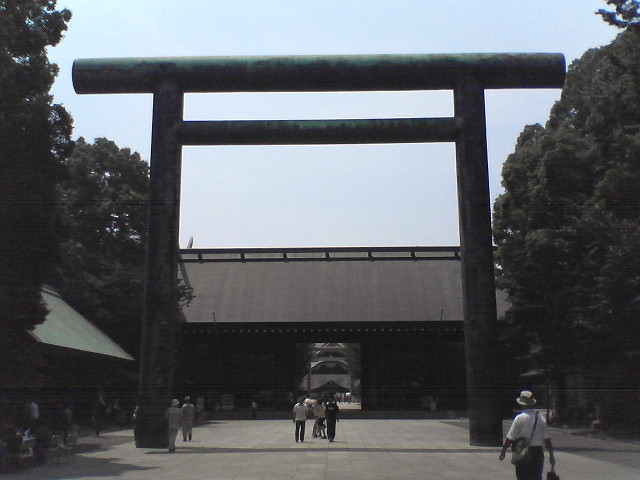
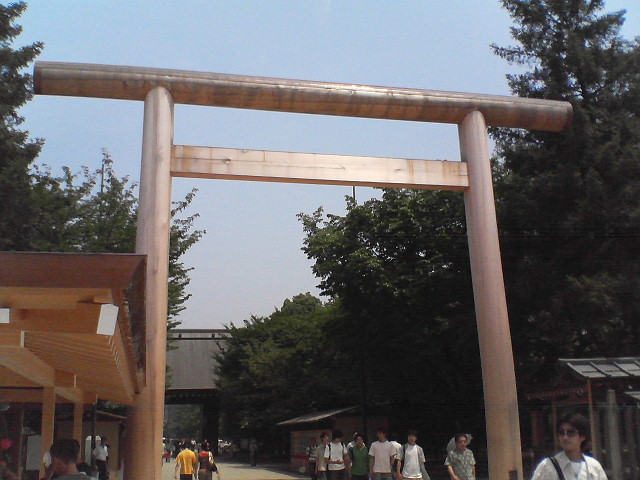
A large torii and the main gate leading to the shrine grounds. Look familiar? No? Try picturing about ten thousand lanterns and spotlights. I was actually at Yasukuni Shrine earlier! Remember the pictures from the matsuri (festival) I posted earlier? I didn't know it then, but I was actually in the exact same place during the festival.

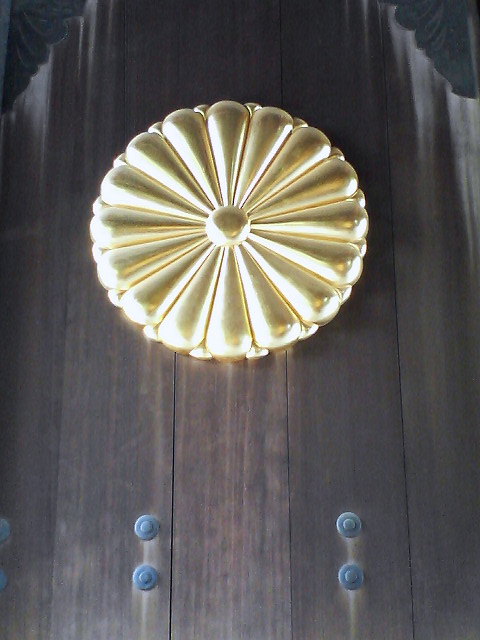
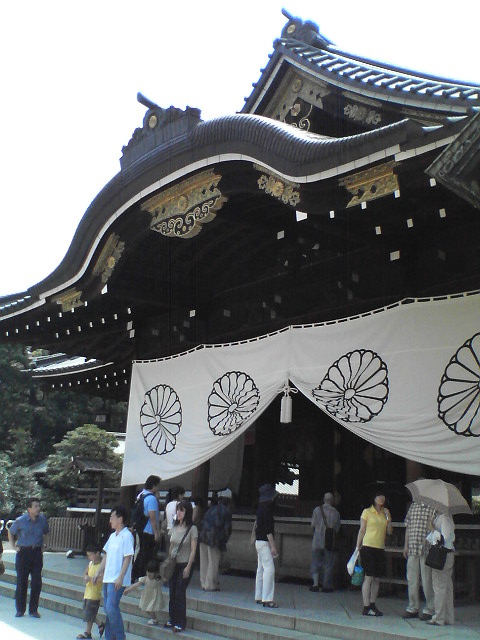
A large gold chrysanthemum on one of the doors of the main gate to the Yasukuni Shrine grounds. This is the imperial seal.

Getting closer to the shrine...

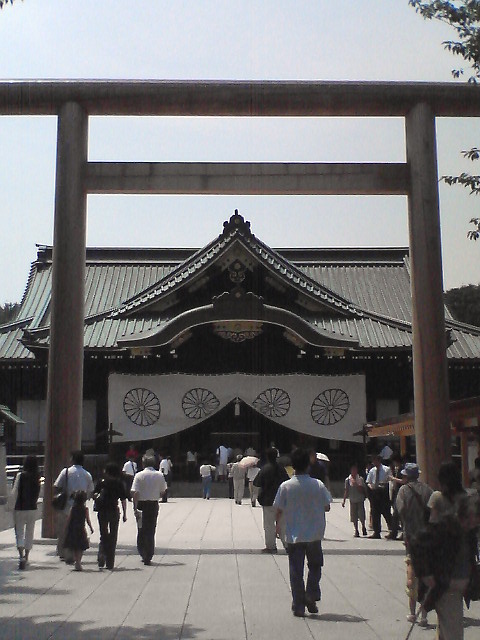
There she is, the controversial Yasukuni Shrine. This is where the Prime Minister visits each year to pay his respects to fallen Japanese soldiers from the various wars. This annual act results in an immediate explosion of international outrage from many citizens in China and Korea, who oppose the fact that the shrine also pays homage to certain individuals who were tried as wartime criminals.

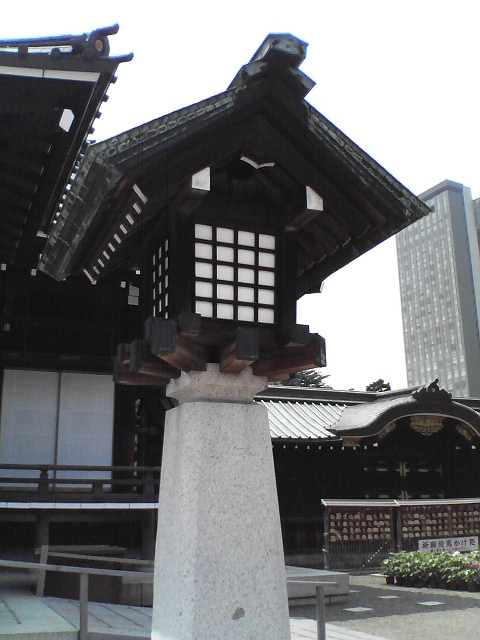
A lantern beside the shrine. Simple in design, but beautiful nonetheless.

A shot looking backwards through the torii towards the main entrance to the shrine area.

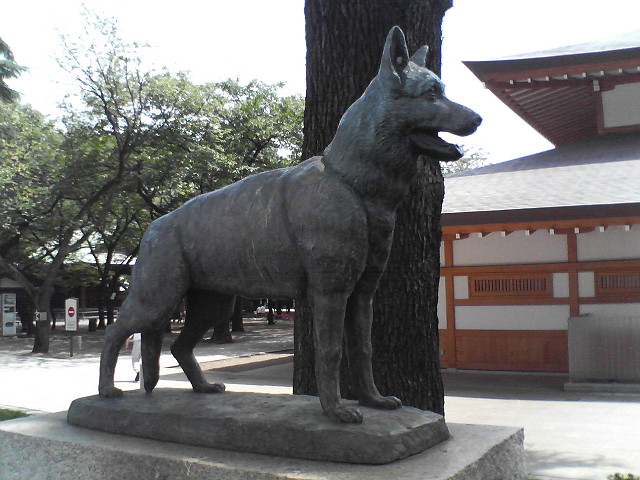
A statue of a dog; the first statue you see upon entering the courtyard outside of the wartime museum at Yasukuni Shrine. I honestly can't tell you what the dog symbolizes...maybe the Japanese peoples' love for sled racing?

A statue of a young Japanese bomber pilot, proud to serve his Emperor.

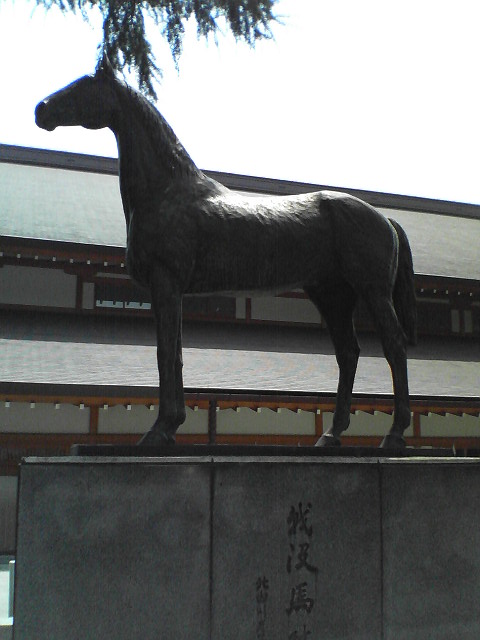
A statue of a horse, symbolizing how samurai warriors once rode through the wooded Japanese countryside.

Another statue in the courtyard outside of the wartime museum; this one is called "The Mother of Japan."

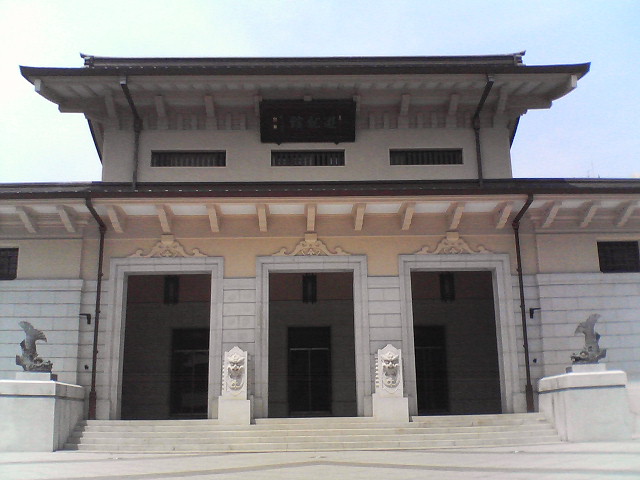
The front of the wartime museum at Yasukuni Shrine.

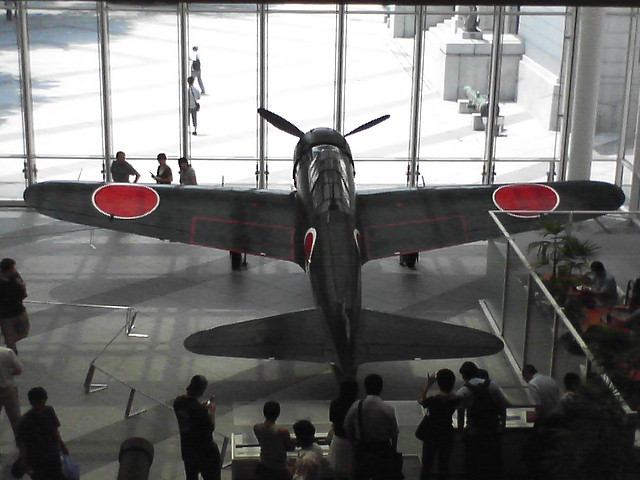
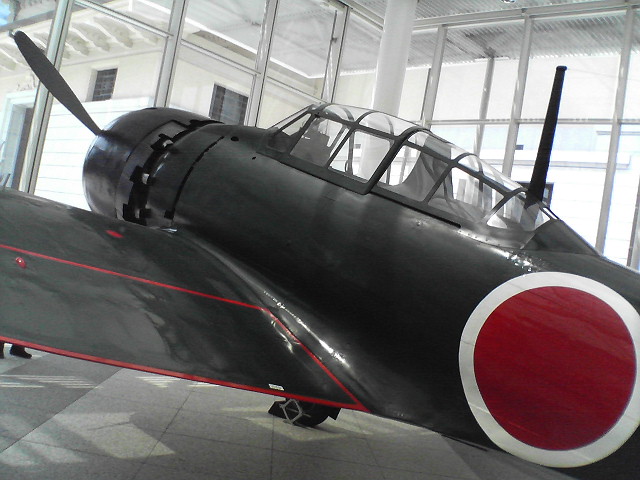
A Japanese warplane like those that attacked Pearl Harbor.

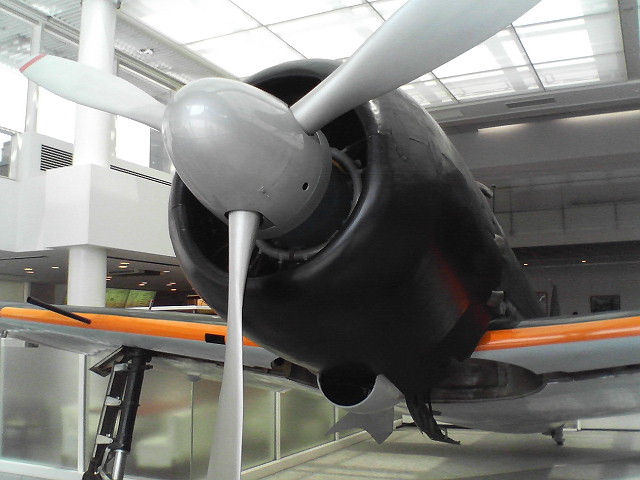
BIG propeller!

The bomber up close.

A white Japanese warplane.

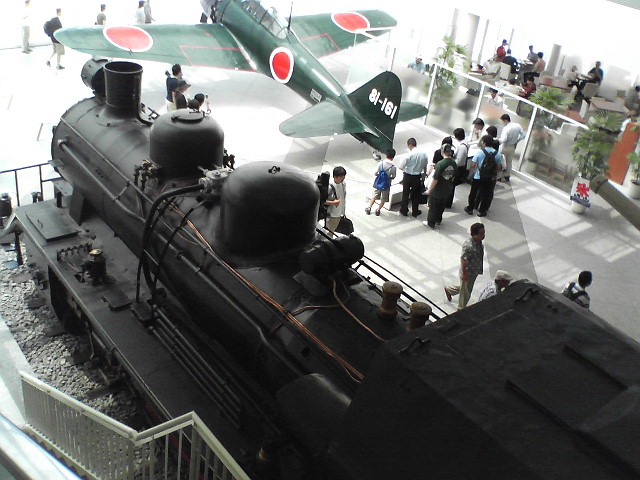
A locomotive on the ground floor of the museum, serving to illustrate Japan's rapid modernization after the isolationist period.

A statue of a lone Japanese soldier.

Here is a statue called "Wartime Friends."

One of many wartime mottos written in Japanese throughout the museum.

Here is the same phrase in English.

A saber used to decapitate enemies during a war.

Some cannons on the ground floor of the museum, right next to the gift shop. Kablamo!

A Japanese tank with different colors than the American versions.

A turret from a warship.

Walls and walls of pictures of Japanese who died in various wars. Some of these people are considered war criminals by China and Korea.

And lastly, my souvenir from the gift shop.

Saturday, August 05, 2006

61 Years Ago Today...


The atomic bombing of Hiroshima.

I guess this is the natural answer to fast food dining?

You may remember an earlier picture of the Condomania contraception superstore in Shibuya. Here is a picture of the greatest set of mascot characters ever created: The Prophylactics, courtesy of the Condomania store in Harajuku. There's Lubey, Pokey, and Ribber!

Found inside the store, here is a mask you can buy to turn your head into a giant condom. Is it just me, or does the giant condom mask look a lot like a KKK Clansman's hood?

"If you only knew the power of the Dark Side. Obi-Wan never told you what happened to your father..."

A giant Gizmo, part of a massive Gremlins toy display in a Shibuya toy shop. Old Giz' looks like he's put on a few pounds in this pose.

Friday, August 04, 2006


The ivory tower of Japan - Roppongi Hills! This is where you rent space from landlord Dennis Hopper when flesh eating zombies become your next door neighbors.

Japanese pop star Kimura Kaela with Doraemon! Her albums and singles always make it to the top 5 in Japan and she is the biggest pop star on my company's rock / pop label. I met her VERY briefly at Columbia and said hello. She's actually quite small - about my height. She has a new single called "Tree Climbers" coming out September 9th, so maybe she'll be around more often and I can take my picture with her if I meet her again!

Me with Doraemon! Not quite as cute as Kimura Kaela, but it works.

Don't know who this character is. Maybe one of Doraemon's friends? Or maybe someone else entirely.

Thursday, August 03, 2006

COMING SOON...


"Living the Dream;" a special series of posts about hard rock, sweet booze, soft women, and Power Rangers...STAY TUNED!

Takarazuka Revue (宝塚歌劇)

*Hi all. I’m sorry about the lack of updates on the blog recently; I’ve been getting home at 12 in the morning just about every night due to live events and just haven’t had the time or energy to write recently. I hope my next posts can make up for my absence as of late. I have a lot of good stuff to write about!*

Below are pictures from my first trip to see the Takarazuka Revue at their Grand Theater home in the Ginza area of Tokyo. I saw the musical “Akatsuki no Roma” or “The Dawn of Rome,” a rock opera based off of the play Julius Cesar by Shakespeare. After the two hour musical was the one hour song and dance revue, "Les Bijoux Brillants" or "Poetry of Glittering Jewels," featuring songs and imagery inspired by precious stones.

I am currently trying (to no avail) to secure tickets to the next Takarazuka show run of “Phantom,” based on “The Phantom of the Opera” (though not the Andrew Lloyd Webber version). However, because Takarazuka musicals are insanely popular in Japan, most seats sell out immediately for every show. Somehow or another, I was able to secure a great seat for the show I went to last weekend.

I will be writing my honors thesis for the Japanese major on the defining features of Takarazuka musical theater and answering the question, can this unique form of Japanese theater be brought to the American stage?

Takarazuka was formed in 1914 by the president of the Hankyu Railway Corporation, Kobayashi Ichizo (you may be familiar with the Hankyu Department Store chain in Japan that still bears his name). Kobayashi wanted to create a tourist attraction for his small city of Takarazuka (about 45 minutes from Osaka) that would increase the volume of people riding the full length of his train line, which just so happened to end in the city of Takarazuka. Created as a comical answer to the all-male kabuki theater, Takarazuka is an all female, highly modern, highly Japanese musical theater tradition that has a fanatically devoted fan base of middle-aged Japanese women.

A Takarazuka show usually consists of a two hour musical play followed by a short intermission, and then a one hour song and dance revue. Upon graduating high school in Japan, young girls may apply to be one of the 50 lucky members of each year’s entering class at the Takarazuka Music School in Takarazuka City, the only training school for this type of theater. The Takarazuka Music School is a highly prestigious school and considered to be the Julliard of Japan. When girls enter the school, they must choose whether they wish to play male or female characters on the stage. Once they decide, it is very unlikely that they will ever switch and play roles of the opposite gender. This is do to the fact that the decisions on what sex to play are often made based on height, look, and vocal range, and each specialization requires its own respective extensive movement and voice training.

There are only two formal Takarazuka Grand Theaters in Japan – one in Takarazuka City, right next to the school, and one in Tokyo. In its near 100 year history, Takarazuka has performed in Europe and North America as well. The themes of Takarazuka musicals are as diverse as the colors of the rainbow striped spandex pants worn by one star during a dance number. Some shows are based on traditional Japanese stories such as “The Tale of Genji,” while some may come from Japanese comics. Others are redoes of western musicals. Take for instance the all female versions of “Guys & Dolls” and “West Side Story.” Lastly, some are strange mixes of Americana, such as the original biopic musicals on the life of Ella Fitzgerald or JFK (the latter which featured a dancing Saddam and Castro). Takarazuka is certainly different from anything on Broadway.

Takarazuka is a money making machine! Not only was every seat at my show sold out, but there was a gift shop (with a fancy French name) that sold every piece of merchandise imaginable. One housewife rubbed a towel with a picture of her favorite actress on it across her face, while another woman loaded up on collector postcard sets at $20 a pop. Thanks to a research grant from Stanford, I was able to buy some stuff, including a $100 DVD video of a musical I wanted to see. One could easily drain their bank account on pencil sharpeners that play snippets of show music when you grind your writing utensils and ashtrays that let you snuff out your cigarettes into the face of your favorite star. This is not to mention the plethora of stalls inside the theater lobby that sell rice crackers with the Takarazuka logo grilled into it or a special kiwi mango flavored snow cone that happens to be favorite taste treat of a top star.

I was seated on the ground floor of the theater, dead center, about halfway back from the stage. I would say that the audience was between 85 - 90% females of age 40 and above. There WERE men present in the audience (some even my age), though most of them looked to have been dragged to the show by their wives / girlfriends / mothers. I was the only non-Japanese person in attendance as far as I could tell. I of course heard gossip about my unusual presence in the theater from the Japanese people in the surrounding rows. The gossip bit was funny, because obviously if a foreigner is going to a musical show entirely in Japanese, they would have to be able to understand Japanese in the first place. And yet, people kept making observations about me as if I was incased in a prison of incomprehensibility.

Here is the complete story of “The Dawn of Rome” in a simple, easy to follow arrow-linked chain.

Cesar is great, people like Cesar --> Brutus makes a speech, people hate Cesar --> Brutus kills Cesar, people like Brutus --> Antony makes a speech, people hate Brutus --> Brutus kills Brutus, Rome is happy! ~fin~

The song and dance review that followed the musical was everything that Takarazuka is famous for; blinding strobe lights, oversized novelty diamond rings, disco balls, glittering rhinestone studded pimp-costumes, and completely random American songs sung in Japanese. Music included, “Diamonds are a Girl’s Best Friend,” Madonna’s “Like a Virgin,” Will Smith’s rap “Wild Wild West,” and one of my real life favorite songs, “So Happy Together” by The Turtles.

Audience participation in Takarazuka is limited to robotic synchronized clapping during the opening and finale numbers. No one gives a standing ovation or calls for an encore as the performance comes to a close. Interestingly however, everyone will burst into applause whenever a performer makes use of the arched runway that extends out in front of the audience. Even if it was a dialogue scene, everyone would burst into applause if a character walked onto the runway – weird.

All in all, I thoroughly enjoyed my first Takarazuka Revue experience. There are links to various pages about Takarazuka on the right side of the page if you would like to learn more. I encourage anyone visiting Japan, who is brave enough, to experience the magic of Takarazuka. Right alongside kabuki and noh and puppet theater, Takarazuka is truly Japan’s modern theatrical tradition. Even if you don’t understand Japanese you should still go! The stories are simple enough that anyone can follow along, and the Takarazuka website provides English summaries of each of the shows they run. Well, what are you waiting for?!

B.E.W.