Friday, May 18, 2007

Honors Thesis DONE! (卒論)


My senior honors thesis entitled: Why is Curly a Woman? Presentationality and American Nostalgia in the Takarazuka Revue 「どうしてカーリーは女か?宝塚歌劇におけるアメリカンノスタルジアのイメージ」is finally complete! After close to a year of hard work, the paper is printed and submitted to my department advisers.

Just for clarification, the paper was written entirely in English, though due to the subject matter, many Japanese vocabulary words, phrases, and concepts were utilized.

In a nutshell, my thesis looks at the Takarazuka adaptation of Rodgers and Hammerstein’s classic American musical Oklahoma!. More specifically, I examine how the all-female Japanese production simultaneously evokes nostalgia for images of American culture but also maintains a distinctly “presentational” (over-the-top) Japanese theatrical style.

If any readers are heading to Japan in the near future, do not miss the opportunity to see Takarazuka. I guarantee you will not be disappointed!

B.E.W.

P.S. - In recent news, my honors thesis has been nominated for university-wide awards. Maybe I'll take home academia's equivalent of the Oscar!

Monday, April 23, 2007

Happy Language Anniversary! (日本語記念日)

In light of my recent 5000th hit, I have decided to write a post about language learning.

By the time I graduate from Stanford this spring, I will have been studying Japanese for ten consecutive years. I have certainly come a long way since my first Japanese class with Ms. Morse at Eckstein Middle School in Seattle, however, every week as I meet with my current teacher Nakamura-Sensei and pour over sample test questions from the Japanese Language Proficiency Exam, I realize how far there is still to go!

My ultimate goal is to be bilingual, or as close to that as a non-native speaker can get. The Japanese have several phrases that speak to language fluency, such as the onomatopoeic word “pera pera,” or the formal word “ryūchō.” Throughout my time in Japan, I found myself telling countless people about my love of the Japanese language and my desire to speak it at a near-native level.

Half of the Japanese people I spoke to, using the word “fluency” to articulate my ultimate goal, would respond that I was already fluent in Japanese and didn’t need to study anymore. While some were undoubtedly being polite, others were genuinely serious. They really couldn’t see why I would want to continue studying Japanese; to them, as a foreigner, I was as good as it gets.

I am always dubious when I hear that so-and-so is “fluent” in Japanese, especially if they are a westerner. Call me jealous if you must, but these aforementioned responses illustrate a common problem with labeling someone as “fluent” in a given foreign language. Namely, what does the word fluent even mean? It means different things to different people. For me, true fluency in Japanese (or any language for that matter) is the ability to freely switch between reading, writing, or speaking different languages, and have there be a relatively small gap in the quality of personal expression.

That is to say, if I were to suddenly switch and continue this post entirely in Japanese, my word choice, humor, and for a lack of a better word, personality, would be largely unaffected. To me, this is the true sign of a fluent individual and the thing to strive for in foreign language study. できるかな?

If you were sat down in front of a camera or tape recorder and interviewed in a foreign language without the ability to speak English (as I have been), what would the quality of your answers be? Would they be radically different from what you intended? Or, would you find that you could freely articulate all the points and emotions you wanted to? Could you make the interviewer laugh and cry at the appropriate moments during your story? These are the questions that plague those in search of language “fluency.”

I would find myself thinking about these questions from time to time when I was in Japan, usually when I was particularly horny and fantasized about kissing and taking a Japanese woman as my future wife. I began to contemplate, if my wife spoke little or no English, would I be able to articulate my “true self” to the woman I loved? Would I appear as a complete person or just half of the funny, charming, and loveable person I could be were I wooing someone in my native tongue? What about my parents? Could they talk to my wife? Would they be upset if they couldn’t?

It all sounds like a reality show waiting to be pitched. A white guy who speaks no Japanese dates a Japanese woman. Taking a cue from a classic episode of I Love Lucy, he wears a wireless earpiece and is constantly being fed what to say in Japanese to impress her throughout the date. At the end of the show it is revealed that the white guy can’t actually speak any Japanese without the help of the bilingual translator and the girl has to choose whether she still likes him or not.

Allow me to shift gears for a moment and reflect on learning Japanese. People often comment that Japanese must be very hard to learn. It is! Well, parts of it are anyways. I don’t know how hard or easy Japanese ranks in the grand scheme of foreign languages, but I would say to speak Japanese naturally is difficult. I have certainly been kept busy over the past 10 years. I love learning foreign languages because there is always the possibility for improvement – there are always natives to speak to, books to read, and things to write. In this sense the sky’s the limit in terms of language growth if one is committed.

People also ask me why I began studying in the first place. I don’t know exactly why I started studying Japanese but I know why I continue: studying and getting better in the language makes me happy. As a kid, I always liked sushi and videogames, but I don’t think either of those products of Japan particularly spurred my interest in the country. More than anything, I started studying Japanese in middle school because it was radically different from English and because I thought (rightfully so) that it would be fun.

It can sometimes be difficult to be a language major at Stanford – a penguin in a flock of seagulls. A friend once asked me what my major was and I said “Japanese.” She responded, “and what else?” When I said that was it, she immediately started backpedaling and telling me how “cool" Japanese was. I laughed…it was fine. Most people at Stanford view language majors as a light snack before dinner, a fun romp when compared to more rigorous engineering or scientific majors. People often pick up a minor or double-major in Spanish / Portuguese, but will rarely devote their entire course of study to the language. The same can be said in my department where only one other guy besides myself is a “true” Japanese-only major. The rest are double-majors or minors.

I hope there is something to be said for those that dedicate themselves to the study of a different language and culture. I am happy that I have made this a priority during my time at Stanford. I very much believe in learning languages and expanding your cultural horizons. I think that is something that the world needs more of.

Japanese is a wonderful language to study…so is any other! What are you waiting for? Get out there and start learning one!

B.E.W.

Saturday, January 27, 2007

Too Late!


While I was searching around the web I found this advertisement for McGriddles. The Japanese reads, 「だれも知らない朝ごはん、はじまる。」 or "The breakfast nobody knows is coming!" When I was in Japan, my beloved McGriddles were nowhere to be found. It seems like they are finally making their way to the land of the rising sun!

About time!

B.E.W.

The King of Beers!


Happy 20th Anniversary Asahi Super Dry!!!

アサヒスーパードライ20周年:
まだ一番うまいビールだぜ!

-----------------------------------------------------------------

Speaking of Japanese beer, if you ever find a store that sells Hitachino Nest Beer (常陸野ネストビール), DO NOT miss the opportunity to sample a truly wonderful and unique beer unlike any other - guaranteed! The Hitachino beer brand is actually produced by a sake brewery named Kiuchi. They make a series of ales brewed with rice – the result is a crisp, refreshing beer that tastes like sake.

Nest Beer (named so because of the cute owl mascot) comes in two varieties, white rice (白米) and red rice (赤米). Both are incredibly complex and flavorful. I was completely unfamiliar with this brand until I happened to come across it at a beer and wine store specializing in imports. If you happen to find a bottle, don’t miss the opportunity to snag a real drinking jewel!

B.E.W.

Saturday, January 20, 2007

Get a Job, Ya’ Bum! (就職活動)


Nowadays every time my cell rings I wonder if it’s the real world calling. I am fast coming to grips with the realization that in a short period of time I will be fresh out of the ‘Stanford bubble’ and charged with the task of finding something to do with my life. This is terrifying to say the least, the stuff of nightmares.

Maybe the guy pictured in the red cap and overalls will be my future employer. Nintendo of Japan slipped five golden tickets into their first one million Wii systems. The lucky soles who find them get to compose videogame music at the Kyoto based headquarters and meet Willy Wonka himself, Super Mario and Legend of Zelda creator Shigeru Miyamoto. Composing game music for Nintendo would be a dream, especially considering my interest in music and entertainment. Is it possible? I don’t know. Is it worth a shot? You bet!

Applying to Japanese companies is a daunting process for a foreigner, made worse by the fact that you begin to doubt if said company is even willing to hire non-Japanese employees to begin with. Most global companies such as Sony, Nintendo, Microsoft, Google, and Amazon.com all have headquarters in Japan that operate autonomously from the American branch. Nintendo of Japan and Nintendo of America are completely different companies and understandably have different job opportunities and management staffs. A typical high school kid who wants to make videogames some day won’t be doing that in Redmond,
Washington, but they might be doing it in Kyoto.

I have the PDF application to be a composer at Nintendo on my computer, but I had to falsely enter personal information into their online database to even get the application. There were no options to receive employment materials if you didn’t have a permanent residence in Japan. Does Nintendo or any Japanese company for that matter want foreigners? I think they do, but one’s way might only come from a Japanese contact within the company or a headhunting firm.

Perhaps I’ll be back at Columbia Music Entertainment in Roppongi. Hey, at least I have friends there already. I have been debating asking my internship coordinator for a job. He also happens to be the director of Human Resources. But would I enjoy my job?

The choice ultimately comes down to what I value more, location or job. If living and working in Japan is my first and most important requirement, then I have to settle for what might not be my dream job. There is a plethora of English teaching and private tutoring jobs available in Tokyo. Other easy-to-enter employment opportunities in Japan include kebab stand operator, tissue packet distributor, and 100 Yen shop manager. At this point I don’t know which I’m leaning towards.

There are plenty of neat companies in Japan such as Miyazaki’s Studio Ghibli and Nana-on-Sha (the makers of the Parappa videogame series) that are just dying to be infiltrated by westerners. But then there’s rock steady U.S.A. Wouldn’t I be crazy not to seek employment in America first? I met the American ex-head of Tower Records Japan while I was working at Columbia. He worked for Tower in California first before they shipped him off to Japan. He rose up the ranks in the Japanese company, ultimately landing at the top, and managed to make the record store chain the most popular in Japan. The same cannot be said for Tower in America which filed for bankruptcy in 2004.

One thing is for certain, however, I miss Japan! With my roommate spending the quarter in Berlin and friends popping off to Australia and South America in the middle of the school year for week long excursions, I really do miss living abroad and I would like to return as soon as possible!

I’ll keep you all posted.

B.E.W.

Tuesday, January 09, 2007

Happy New Year!


新年明けましておめでとうございます。

Welcome to 2007 everyone! Best wishes for a healthy and happy new year. 2007 is the year of the boar or "inoshishi" (猪) in Japanese.

では、今年も宜しくお願い致します。

B.E.W.

Monday, January 08, 2007


Here is a picture of the Fujiya department store. I happen to think the rainbow coloring and reflective exterior make the building look really neat.

Here is the Pallete Town section of Odaiba island. Is it just me or does Palette Town sound like the central hub in a videogame?

A giant Hello Kitty bounce house in Palette Town.

My mom walking down a typical narrow Tokyo street.

A picture of a similar Tokyo street at night.

Me in a rickshaw at the Edo Tokyo Museum.

Saturday, December 02, 2006

Going Home (帰国)


This concludes our broadcast…

While I was away, the bathroom in my Seattle home got a new addition. Staring at this Toto Washlet toilet in my American bathroom, a mirror image of what my rear graced countless times while in Japan, I cannot help but feel that all things come full circle...

A typhoon hit Tokyo during my last week. Tokyo Disney Sea was wet, but when departure day arrived, waves of water rolled down the street near my Asakusa Weekly Mansion and the howling wind was easily audible outside my window. I needed to wire money to my host brother in Kyoto to close out my mobile phone account, so I braved my way through the torrential onslaught, trudging through ankle deep water to a nearby convenience store ATM.

Even with written directions from my host brother on how to transfer money to his account (displayed on my cell phone in Japanese characters), I was still completely baffled by the electronic process and had to enlist the help of the friendly store clerk. He was very patient and I eventually got the money sent after several unsuccessful attempts at punching buttons on the machine myself.

Japanese ATMs also have no deposit or withdrawal limits, so I was able to take all of my summer internship earnings with me in a huge stack of cash – just like an international drug dealer. I left a hundred dollars in the account to keep it open. Now, when I become a super villain, I can rightfully say that I have an “offshore account.”

After the banking was taken care of (and I was thoroughly soaked from the roundtrip), I was ready to check out and head to the airport. Leaving my Asakusa Weekly Mansion was a painless affair. There were no additional charges on my account, so I signed a piece of paper and walked out the door. I can’t say that I was particularly sad to leave my broom closet prison cell.

A special train line runs directly from nearby Ueno to Narita International Airport. The ride was very quick, clocking in at only a little over an hour, but the train cars were absolutely packed with people. I had to stand for ¾ of the ride, smashed in between people and pieces of rolling luggage, as the train sped through the icy rain. Luckily I had shipped my luggage ahead to the airport so I only had to deal with a backpack.

United Airlines only allows two pieces of checked baggage, so I had to pay the equivalent of $170 in yen in order to check my third bag. I was infuriated at the astronomical cost, but there was nothing I could do – the airline had me over a barrel. I spent my time in the airport looking in the shops (they have a whole mall in the airport). There is also an observation field with benches and tables where one can sit and watch the planes take off.

I don’t remember how long the flight back was, but it was certainly shorter than the trip over. I watched several movies and ate the same crummy vegetarian pilaf. Before I knew it, I was staring at a blue customs declaration form on my tray table. I had no idea what to write on the form as I was bringing back suitcases filled with CDs, DVDs, and videogames. Most of my booty was personal gifts or unmarked audio / video product samples from Columbia, so I didn’t know how to accurately estimate their value on the form. I filled in some ballpark prices and took a gamble that the customs agents wouldn’t care.

In customs, one particularly annoying male agent decided to harass any person under the age of 25. He paced around the group and interrogated any college-age kid he could find. Things went well once I told him I was a Stanford student and started gushing about my summer internship at Columbia, after he asked me to describe what I did in Japan. Not knowing anything about Japan, the agent quickly disengaged me. He stared at my blue form with the itemization “CDs / DVDs = $500” and then stared at me. “Five hundred dollars huh? That’s how much it cost? You’re not bringing back like hundreds of CDs are ya?”

I didn’t have the heart to tell him that he was actually correct – Instead, I told him that CDs and DVDs are very expensive in Japan (which isn’t a lie). All things considered, customs was just fine. The only things the authorities seemed concerned with were powdered or liquid curry packets. Since I didn’t have either, I was home free.

…I am now in my senior year at Stanford, and busy myself with advanced coursework in Japanese language and literature, preparing for the Ministry of Education’s national proficiency exam. I am also writing an honors thesis for my major on the subject of the all-female Takarazuka Revue Theatre Company.

I hope that my stories were funny and entertaining when they needed to be, but also educational and inspiring as well. If you enjoyed my adventures and learned something new about Japan, then I did a good job. Japan is truly a country unlike any other in the world and a place that I love dearly. I urge all of you to experience it first hand. What are you waiting for? Make your own adventures!

Finally, I would like to thank all of the friends, family members, and strangers who read, commented on, and enjoyed A White Boy in Japan. Usually blogs like this only benefit school friends and grandparents. I feel privileged to have had people from all over the world reading my musings.

This blog will remain active and open from now on. It is now possible to read my entire adventure from beginning to end! While frequent updates on the site will drop to a minimum, I will post any and all new information regarding my senior thesis, Japan job search, and future Japan trips on this website, so please don’t forget the address!

I will leave you with my favorite Japanese quote, straight from the special edition DVD poster:

「自分が見えない時は、ライオンキングを見ればいい」

“When you forget who you are, watch Disney’s The Lion King.”

Thank you for reading.

Most Sincerely,

Benjamin Evan Whaley
A White Boy in Japan

Coming soon to an American bathroom near you!

Tuesday, November 21, 2006


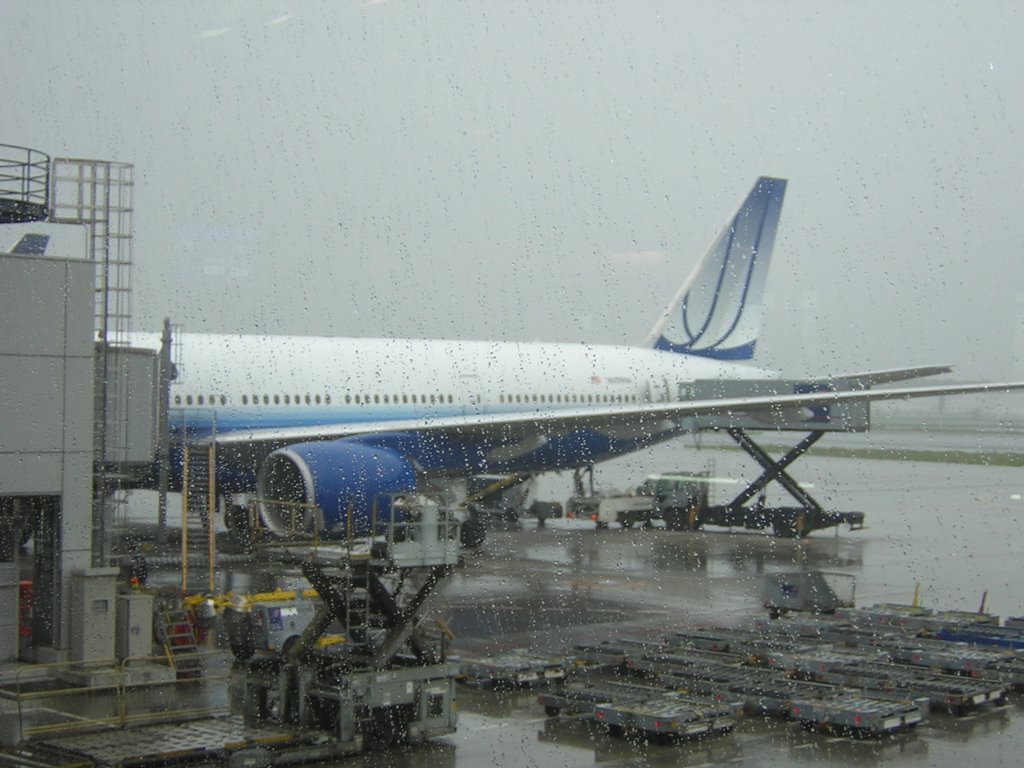
A shot of my plane back to America in the torrential downpour. Tokyo's typhoon season puts Seattle rain to shame.

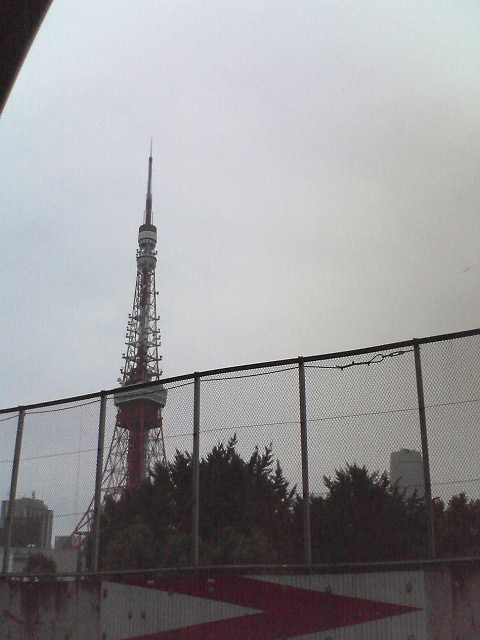
A quick shot of the Tokyo Tower on the way to the airport.

Wednesday, November 08, 2006

Closing Time

My last week at Columbia Music Entertainment (CME) was spent divided between the Intellectual Property Rights Division and the Human Resources Department. My time in IPR was largely spent receiving lectures on copyright law and the intricacies of licensing agreements. CME owns the rights to and is currently licensing a large selection of songs from Japan’s most famous and beloved folksinger Misora Hibari. Though she died of cancer in 1989, her likeness and music continue to sell products and grace billboards throughout the country. The agreement I looked at dealt specifically with licensing her music for use with a new electronic pachinko machine that bears her likeness. Cha-ching!!!

The IPR division had me translating addendums to licensing agreements between CME and Apple Computer’s iTunes Music Store. Understanding legal jargon in English is hard enough. As expected, translating the thick legal jargon from Japanese to English was quite a challenge, but valuable practice for me. In order to concentrate, I found that I needed to be in a completely silent environment while translating documents.

It didn’t help my concentration that my desk was located next to my internship coordinator and head boss Okano-san in the Human Resources area of the 10th floor. They didn’t have a free desk on the other side of the floor where the IPR division was located. Because of my close proximity, Okuno-san would occasionally override the tasks given to me by my boss in the IPR section, and ask me instead to spend 30 minutes looking over and editing the PowerPoint file he would present to the American investing board later that afternoon. I would then have to spend an additional hour going over the corrections with him in person, during which time he would ask me mind-bending English usage questions such as, “What is the difference between ‘a’ and ‘the’?”

I spent the second half of my last week at Columbia in the Human Resources Department, right where I had begun my orientation two months ago. I didn’t even have to change desks and Okano-san was gracious enough to treat me to lunch during each of these days at our favorite nearby fish restaurant! In between trips to the fish restaurant, I sat at my desk and created a sweeping PowerPoint presentation that documented my internship experiences at Columbia. I had just a few days to go before I was scheduled to present to the chairman and CEO of the company, Hitose-san.

Friday arrived before I knew it. Okano-san had warned me that Chairman Hitose-san could only spare 45 minutes from his busy schedule to attend my internship presentation. Everything would be fine, assuming we got the ball rolling on time. Due to a room scheduling conflict, I found myself dressed in my best business casual, laptop hugged to chest, waiting for the executive boardroom on the 11th floor to open. When the black suit clad Japanese businessmen finally filed out of the room fifteen minutes later, it was my turn at bat. We got the projector hooked up to my laptop and working in record time: 10 minutes! We were already seriously behind schedule and this only added to my anxiety and pit stains.

Chairman Hitose-san is a self-proclaimed “ojisan” (old guy). He is close to seventy years old, with a mole spotted bald head and thick black glasses. His wrinkly skin is usually covered by blue jeans and a white polo shirt – today was no different. His office is filled with stacks of CDs that nearly reach the ceiling, and framed pictures of him posed with the company’s young pop stars adorn his walls. Co-workers told me that he has a Harley but can’t actually ride it. Imagine a grandfather, who is desperately trying to be as hip as his teenage grandkids; that is Chairman Hitose-san in a nutshell.

As I began delivering my final presentation in Japanese, Chairman Hitose-san closed his eyes, leaned back in his over sized leather chair, and promptly went to sleep. He would sleep for the entirety of his time in the room, mouth hanging slightly eschew, waking about thirty minutes later in order to silently leave the room and never return.

It is difficult to deliver a presentation to someone who is sleeping. I didn’t know quite what to do or who to direct my speech to. I took the tact of looking up at the back wall and pretending I was delivering a proclamation in an amphitheater. This was because the other eight random attendants at my presentation were at the complete other side of the massive boardroom table. If you can recall the scene in Batman where Bruce Wayne and Vicki Vale sit across from each other at the giant dinner table, then you have some idea of my misery.

I plowed ahead as best I could, flipping through slide after slide of pictures and Japanese text as sweat beads collected by my sideburns. I was determined to energetically recount my internship experiences for the yawning faces that I had never met. The only saving grace in the room was Okano-san and my friends from Human Resources, who listened and genuinely looked interested in what I had to say.

Okano-san had insisted that I put a section in my presentation that can best be described as “The White Boy’s Suggestions for the Company!” He thought this would be avant-garde. Thus, I spent ample time trying to articulate my interesting suggestions for business and marketing strategies in Japanese. This was the only aspect of my presentation that I felt was a complete waste of time. I felt awkward giving suggestions about how to run a company I had only been a member of for two months, and I don’t believe that any attendees in the room actually cared to hear my suggestions (even though some of my ideas were quite good).

I finished my presentation and received the obligatory compliments from people who yawned and wiped their eyes as the lights came up. Okano-san made an excuse on behalf of Chairman Hirose-san as I disconnected my laptop from the projector. I am proud that I delivered a full presentation entirely in Japanese to important company executives, even if they were less than engaged.

I spent the next several hours making my rounds throughout the company and saying goodbye to the real treasure of CME; the people who work there. My first stop was the studios on the sixth floor. I had spent time there goofing around on the digital piano (the only one I could find in the entire company) and cutting together some cell phone ring tones featuring the old Masked Rider show theme songs. The kids who work in the studio are my age, and they always have snacks there which I help myself to. We chatted about Japan and America and the possibilities of studying and living abroad. They wished me safe travels back to America, saying they were jealous and wanted to join me. I said I was jealous of them and wanted to live in Japan. We added each other as friends on MIXI (a Japanese social network website like MySpace), so we could stay in touch.

I popped into the sales and advertising divisions but most of the people were off working various live events, so the floors were desolate. Since I didn’t exactly bond with the people in these sections nearly as much as with my friends in Enka and anime, this wasn’t overly disappointing.

My last stop was the hardest one to make, the eighth floor, home to the Enka and anime divisions. By and large, the wonderful people in these two sections are responsible for giving me a truly once in a lifetime opportunity that I will carry with me till the day I die. It was a pleasure and a privilege to work with these people that I can now legitimately call my friends.

Many commemorative pictures were taken with my coworkers from both sections, and I will post them as soon as my friends in Japan email them to me. As I was taking a picture with the youngest and most attractive female employee in the Enka division, Boui-san (pronounced boy), my three older female friends kept yelling at us to get closer together. “Put your arm around her Ben! Okay, good…yeah. Boui-san stop laughing! Good. Okay, just like that…like you’re gonna kiss. When you show this picture to your friends in America, tell them this is your girlfriend!” They cackled as they snapped the digital stills.

By the time I left the eighth floor I was towing along two bags, bursting at the seams with gifts of all sorts. Much like an airborne virus, the realization that this was indeed my last day at Columbia, slowly swept across the eighth floor, affecting all those within its reach. My three female friends from the Enka division became my talking shadow, following me around the floor as I shook hands, hugged, and said goodbye to many people. My parting words were always followed with the interjection, “Don’t you have anything to give him?!” Once any of my female bodyguards interjected this remark on my behalf, panic would shoot across the face of the coworker I just said goodbye to, as they began to frantically rummage through their cluttered desk in search of a gift.

I made out like a bandit! My bags were chock full of dish towels, CDs, entire anime DVD sets, and stuffed animals, just to name some of the items. A few coworkers gave me some neat retro Japanese toys and figures. Another friend, nearly tipping over his desk lamp in a panicked frenzy, thrust his own glasses case at me with outstretched arms. “Here, take it! I want you to have it. It is from Kyoto.” I tried to refuse but he insisted again and again. I now have an intricately decorated purple and green flower print glasses case in my dorm room at Stanford.

I left the eighth floor, walking backwards and waving goodbye. My eyes were damp but I kept it together. Chairman Hitose-san had gone home for the day, but I did my samurai duty and brought my gift for him, a book about Seattle, up to the executive floor and left it with his secretary. I wrote a personal note in Japanese thanking Hitose-san for providing me with this wonderful internship opportunity and attached it to the gift.

I walked back to my desk on the tenth floor and returned my magnetic keycard and laptop – it was time to go. Okano-san and my friends in Human Resources insisted on an old fashioned “miokuri” or send off, accompanying me in the elevator ride down and all the way out to the front of 21 Mori Building. Outside there was a light rain falling and it was already dark. I presented Okano-san with a parting gift to show my appreciation – a Seattle smoked salmon with a similar handwritten note of thanks in Japanese. We all shook hands, bowed and hugged.

I walked up the stairs to the blue sky bridge and crossed over the cars whizzing by on the four lane street below. I stopped halfway across the bridge, turned around and waved my final goodbye. As I expected, my coworkers were still huddled together in front of the building’s entrance, waiting for me to disappear out of sight. Before I knew it I was on a train heading home, my time at Columbia Music Entertainment already behind me.

B.E.W.

Thursday, October 26, 2006

Tokyo Disney Sea!


“You’ve just completed an internship at Columbia Music Entertainment, it’s your last full day in Japan…what are you gonna to do?”

“I’m going to Disneyland!!!”

…actually…Tokyo Disney Sea Resort to be accurate. Naoko, me, my friend Inoue and his girlfriend all headed to Disney Sea in Chiba for the day. The theme park, which just celebrated its 5th anniversary this year, is actually about twenty minutes outside Tokyo, located right next door to Tokyo Disneyland.

Disney Sea is a relatively new “themed” theme park much like Disney’s California Adventure. The theme here of course is sea travel. The park features “ports of call” in lieu of the traditional “lands.” Examples include Mermaid Lagoon from The Little Mermaid and the Arabian Coast straight out of Aladdin. All of your favorite Disney friends can be spotted at the park too, except they are all in sea apparel. There’s Captain Mickey, first mate Donald and pirate Goofy, just to name a few.

In order to maintain an atmosphere that feels foreign and magical (i.e. not Japanese), all the writing on signs and in brochures in the park is either in English or bilingually printed in both English and Japanese. Also, 1/3 of all the music lyrics and recorded voice material is also in English. All the park employees are required to speak fluent English, and, upon careful inspection, one will see that there are no vending machines in Disney Sea. There are also no opportunities to buy Japanese food within the park.

The gateway to magic is the “World Bazaar;” Disney Sea’s version of Main St. It is a big plaza area which houses tons of souvenir shops and restaurants. Behind the entry way is Mediterranean Harbor, the large man-made lake that serves as the backdrop for the park’s shows.

The show we saw at Mediterranean Harbor was the large nighttime show entitled “The Legend of Mythica.” Inoue and his girlfriend had a spot staked out to the right-hand side of the lake, but Naoko and I got swallowed up by the swarms of people on the way back from the bathroom. It didn’t help that you couldn’t simply walk from the bathroom area to where he was; we had to ascend and descend various staircases in a giant castle that blocked our way.

Mythica told the story of Captain Mickey and his Disney crew’s voyage to the magical island of Mythica. All the Disney characters spoke a mishmash of Japanese and English during the show, but their characteristic voices sounded the same. Once at said magical island, our Disney friends discover magical unicorns, phoenixes, and other mythological creatures (each represented by convincingly animated water floats). Actors on decorated Jet Skis zoom around in the water as illuminated kites sail high above in the air. Everything is great…until the Fire Dragon arrives! The climax of the show came as Captain Mickey, riding on the back of his new friend the water dragon, did battle with the evil Fire Dragon to protect the Island’s magical crystal.

Fire and water jets shot across the arena at each other. At least I think they did. I couldn’t quite tell, because I was in back of a father hoisting his child up on his shoulders. By this point in the show, Naoko and I had abandoned our effort to rejoin Inoue and his girlfriend, and were pinned against one of the walls of the giant castle, enjoying the show as much as we could.

The trademark Disney fireworks erupted over the park as a voice proclaimed that the secret crystal of Mythica was really love and friendship. Who’d have guessed? Then, the bright calypso orchestra boomed in for one final rendition of everyone’s favorite song. This time I could sing along to the English lyrics, having heard the piece several times during the show:

“It’s the beating of our heart
It’s been there from the start
It joins all of us in harmony”

Due to some lapses in communication and a generally slow start, our group didn’t arrive at Disney Sea until the early afternoon. Since the coming Monday was the national holiday “Old People’s Day,” the park was absolutely swamped with families (send some of these people to Disney Paris!). We also encountered monsoon rain during the last third of our park visit. I was happy to see that Tokyo Disney Sea patrons also bought and utilized yellow Mickey Mouse ponchos.

The waiting time for the rides was pretty awful, even with the Fast Pass system. We waited two hours to ride “The Tower of Terror.” I had already been on this ride at Walt Disney World in Florida, but it was a newly completed attraction at Tokyo Disney Sea, so everyone in my party clamored to go. The actual ride was the same as in Orlando, except it featured cutesy Disney skeleton characters instead of a Twilight Zone theme. The other translated ride we did was the Indiana Jones Adventure. This was Naoko’s favorite ride. It was the same as the ride from the California park, with the exception that Indy congratulated us in Japanese once we escaped the giant rolling boulder and made it to the exit of the temple.

The rest of the rides we did were Japanese originals. They included:

“20,000 Leagues Under the Sea” – A ride where you climbed into a miniature submarine and peered out the windows in order to see alien-like underwater sea creatures. I think we battled some sort of white squid create and obtained a magical crystal (this seems to be a beloved story format at Disney Sea). I don’t know for sure though, because I started to feel really nauseous as the ride went on.

“Storm Riders” – A motion simulator where you rode in a weapon enhanced blimp. Our goal was to fire a missile into the heart of a raging twister in order to disarm it. When our missile backfired and crashed into our ship, holes appeared in the theater walls and water started to spray us in the face.

“Journey to the Center of the Earth” – A Splash Mountain clone, where you dive deep into the earth to a land of mole people while riding in a mine car. At the end of the ride you blast out the top of the volcano Mount Prometheus to escape the explosion of lava. Too bad nobody gets wet!

I was surprised by the fact that the food in the park was actually pretty darn cheap. The four of us ate a light dinner at an all-American themed restaurant in the American Waterfront port of call. Nothing but baked beans, corn bread, meat, and taters. YEEHAW PARTNER!

As the torrential rain got stronger, we decided it might be a good idea to head back instead of more souvenir shopping. My only souvenir was Mickey Mouse Senbei (rice crackers - see picture below). Inoue and his girlfriend were nice enough to buy them for me. The four of us traveled as far as Shibuya Station together in Inoue’s car. We said our goodbyes and I headed on a train back to my place in Asakusa. It was the last time I saw Inoue and Naoko. Naoko offered to come with me to the airport, but I told her to enjoy her day off. I would leave Japan the next day.

B.E.W.

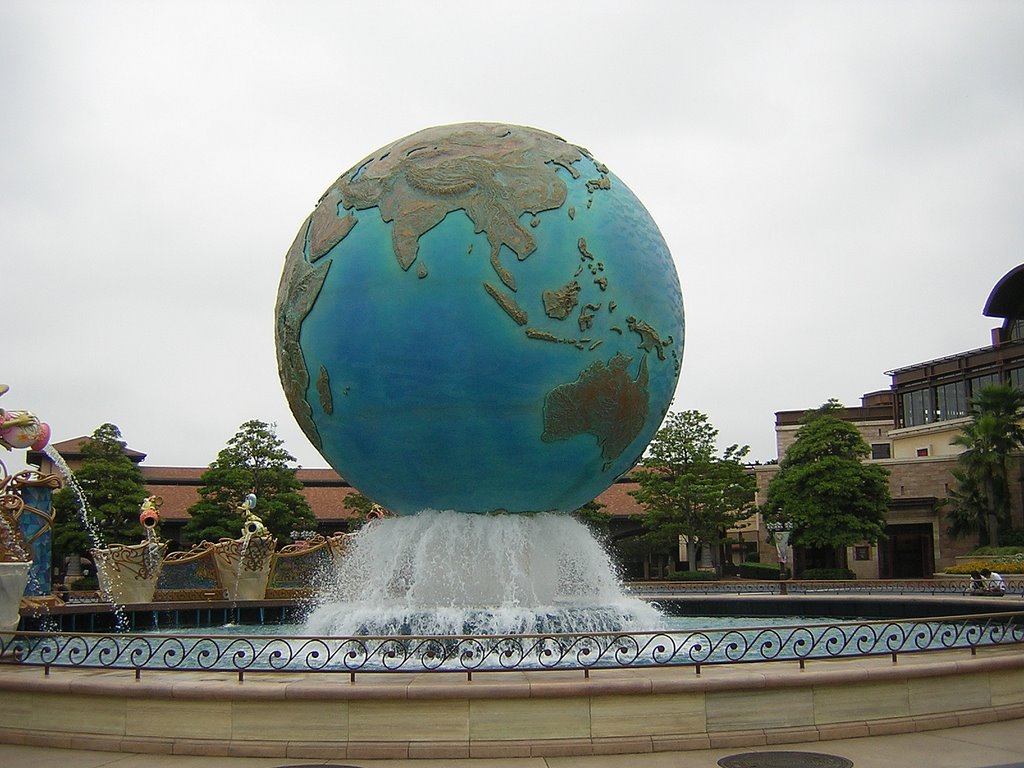
This giant globe welcomes you to the Tokyo Disney Sea Resort in Chiba Japan. Disney Sea celebrated its 5th anniversary this year. The park is right next door to Tokyo Disneyland. Instead of Main St., Disney Sea has the World Bazaar shopping area with lots of souvenir shops and restaurants.

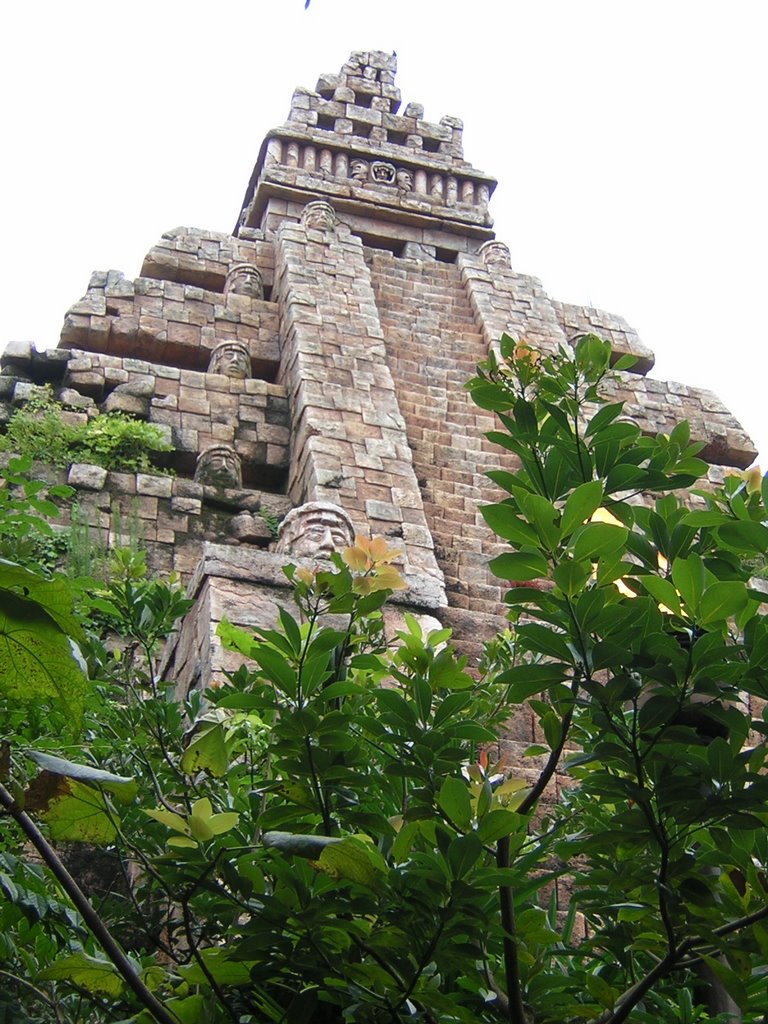
Here is the Temple of the Crystal Skull from the Indiana Jones Adventure ride.