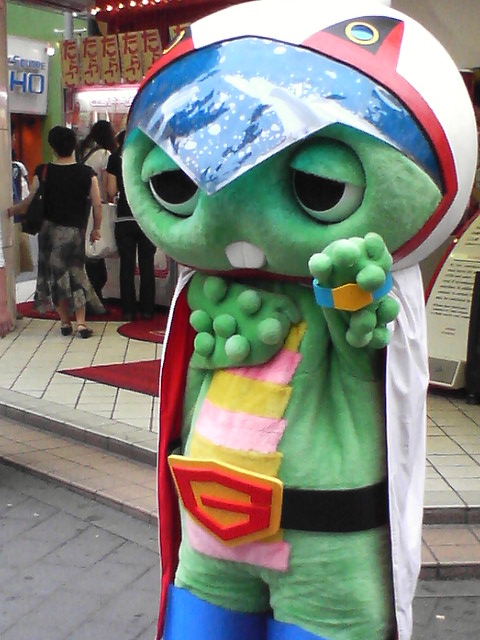
For the next two weeks I will be working in the anime and videogame music division of CME called Columbia House. Thus, my two weeks working in Columbia Records (the enka or country music division of CME) have come to an end and I’d be lying if I said I wasn’t sad to go. My birthday was marked with a special sushi dinner with some of my co-workers, and the experience brought me even closer to them. As we drank and ate all the raw fish our bellies could handle, a friendly war of words broke out between Shimura Bucho to my left and co-worker Rurika (an interesting name even by Japanese standards) across the table.
Shimura-san kept explaining to me the subtleties in usage of the phrase “stupid idiot” as it referred not only to Rurika as a person, but her thoughts and behaviors as well. With his so-called “back alley Japanese,” he instructed me to call Rurika “wrong in the head,” sticking his tongue out as he twisted his index finder around and around by his ear. Rurika responded by telling me that Shimura-san never says any complements and instructed me to call him “a dirty old man.” While it may seem like this was a mean spirited fight, it was in fact friendly in nature, similar to a brother and sister.
This type of name-calling and play fighting is something that I’ve seen over and over again between work colleagues. I attended a BBQ last weekend with my enka section and as we drank more and more, the behavior got more in line with this observation. The section’s sub-leader began hitting everyone in the head with his folding fan. He walloped me on the head and told me to “pay attention” as he asked me in Japanese what I thought about Japanese girls’ lack of boobs and forests of pubic hair (I’m not kidding!). Indeed, I think my eyes traveled over to some of my same-aged female colleagues during our conversation, which is why he plunked his fan down on my noggin.
To some, these types of questions may seem alarming or inappropriate, but I was not caught off guard at all. As I wrote earlier, the concession in Japanese business is that your work and section colleagues are the people you trust, they are the people who know you, and they are the people you can truly be yourself around.
Returning to the point of play fighting, our BBQ concluded with a massive water fight. I’ll hazard a stereotype at this point and assert that Japanese people LOVE splashing each with water. The weapon of choice was the ice cold reservoirs of H20 that had collected in the drink coolers. Several co-workers were targeting another guy at one point and they used me as the bait. Once the mark and I struck up a conversation in Japanese, the guys ambushed him and drenched him in water. A bucket full of ice cold liquid came down over me as it did to just about everyone there. You work hard in the office so you can relax and play hard when it counts.
It is hard to believe that I have only been at work for two weeks – I have already seen and experienced so much! You can read about all the people I met below. One more celebrity should be added to the list, an older female enka singer named Kaneda Tatsue. I sat in on an interview being conducted at CME for a music magazine and got a chance to talk with her after the reporter finished.
The three people in the company who can speak English fluently (one of whom is the company president) were there with me in case I froze up during the after-hours Q&A, but we all spoke in Japanese so it worked out well. To my surprise, it was Kaneda-san’s agent who liked me the best. She said I could send her my demo tape and wants to have lunch with me because she thought my views on cultural exchange were very interesting. I guess this is because I went off on one of my favorite topics about how Japan is so important economically and culturally in the world, but yet most people see it as an impenetrable enigma. In my opinion, most people don’t know what to make of Japan. My blog probably doesn’t help this fact.
Meeting famous people is always weird, and it is made even weirder when you try to do it in a foreign language. I can say however that I am now as used to it as I am going to be and that I am rarely nervous anymore. Because Japan is a hierarchical society, the spoken language of Japanese differs when you talk to people of varying ages and social positions. The Japanese terms are sonkeigo (honorific language) and kenjyogo (humble language). Basically, it corresponds to, “anything you do is great” and “I am slime.” Thus, when I refer to “I am slime” Japanese, I speak of the way that one must humble themselves in front of superiors.
It is worth noting that these types of speech are very difficult to use effectively for both foreigners and native Japanese alike (they do not teach it in Japanese school). You in essence have to constantly adjust your speech on the fly to put down yourself and put up the other person. This is not only in meetings; it is true when one company calls another and whenever a salesperson addresses the all-valuable customer-sama.
And now, my guide on how to meet famous Japanese people:
Step 1 - Can I come in?) Unless you are a company president or have made a name for yourself in the entertainment industry, if you are meeting any sort of famous people, the chances are that you have a Japanese native insider as a guide. After your superior has knocked and the dressing room door has opened, he or she will begin with a short one or two sentence introduction about who you are and where you are from.
For instance, “This is Ben Wha…Whele…Whe…Whaaa…uh…(pause)…Ben-san. He is completing an internship program at Columbia Music Entertainment and is a student from Stanford University.” At this point, the famous person will glance in your direction and ask the Japanese superior a benign question about you without acknowledging your presence. An example question would be, “Is Stanford University located in Boston?
Step 2 - Entering) When it is your time to enter, the Japanese superior will flutter his upturned hand in your direction. As you enter the room you must first bow deeply and say a set phrase in Japanese which translates into, “I am very sorry for disturbing you and I apologize for the hindrance of my plump and unsightly American face.” When standing, it is important that you stand upright with your hands at your sides (if you are a boy), or your hands placed in front of your abdomen, one placed on top of the other, (if you are a girl). It is also very important that you stand as close to the door as possible. This is the most vulnerable position in a room in Japan and it signifies that you do not intend to stay long and are on your way out.
You are to stay standing upright and not sit unless instructed to do so by your host. If you are asked to sit, you must either completely rest both feet flat on the floor, or completely fold one leg over the other to create a stereotypically homosexual image, while squishing your private parts to the side of your opposing leg. An average guy’s most common way of sitting where one rests the foot of one leg on the opposing knee of the other, thus forming a triangle shape with their legs, is an automatic “batsu” (X). Feet are considered uncleanly in Japan, and in any sort of formal occasion, showing the soles of your feet to a guest is considered very impolite.
Step 3 – Introduction) You must now say a self introduction in Japanese using the appropriate “I am slime” form which explains your humble circumstances. You must not introduce yourself for too long; a length of two sentences is appropriate. When I met my first famous person, I introduced myself for way too long and saw the glaring eyes of my Japanese superior like the rising music at the Oscars as a sign that it was time to wrap up.
Step 4 – Q&A) If it is a short Q&A session you will only have the opportunity to explain that Stanford University is located in the state of California and give a brief overview of the geography of the United States. If it is a longer Q&A session, be prepared to explain your interest in Japan, what is hard / easy about studying Japanese as a foreign language, the fact that Americans do in fact eat white rice, and anything that you were particularly “surprised by” since coming to Japan. Differing from Westerners, Japanese people are much more interested in your opinions and experiences as an outsider in their society, rather than your life and family history. If you do get questions about your life, it will likely be superficial things such as, “What kind of place is city X” or “Do lots of people know about sushi where you live?”
Step 5 – Wrapping up) Depending on how engaged the famous person is, there may or may not be a section where you two stare at each other while reaching for something to say. In any event, this awkward silence will almost always be ended by your superior, who will signal that it is time to go. It is strange, but you can always feel when this time is coming so you don’t have to worry about overstaying your welcome.
Step 6 – Leaving) You are to leave as you came, by bowing deeply (this may be followed-up by several short bows in rapid succession), thanking the person for their time profusely, and saying a set phrase in Japanese which translates into, “I am leaving now. Your time has been a peach blossom scented blessing and I apologize for the lingering stench of my presence.”
There you have it - How to meet a famous person in a nutshell!
I’d like to close this post with a method to live by; “Put in Effort” or in Japanese, “Doryoku o Ireru.” If you are a foreigner living and working in a different country as I am, it is no surprise to any native that you do not fit in. In fact, no matter how well you may know the customs, speak the language, adopt the slang, or hold hands with a partner, you will always be an outsider simply because you don’t quite fit in. The sooner you come to grips with this reality, the sooner you can pat yourself on the back about how far you’ve come and the risks you take on a daily basis; living, communicating, and thriving in a society that is not your own.
What I have learned so far is that when you are placed in difficult foreign situations, you may be scared and you may feel awkward and you may want to quit. These feelings are only natural. What matters in situations like this is that you put in the effort to get the job done. This is especially true in Japan, where effort is rewarded with its weight in gold (or rather respect).
If you go through the motions and give it your all, regardless of whether you ultimately succeed, you will always be rewarded. You give off the sensation that you are type of person who is not afraid to put yourself out there in a frightening situation and take a risk. Because many similarly aged Japanese people are afraid to do precisely this, if you take the plunge, the people around you will be awed and you will feel great about yourself.
On that note, as hard as it was, I contacted my dream girl Mina (see Columbia Rose below). She’s in Osaka this weekend promoting her new single, but we made a date to go out and have a sushi dinner together when she gets back.
Next week it’s ANIME; I’m only getting started!
B.E.W